If bio-intensive growing explains how a small farm produces so much, biodynamics explains how it can keep doing so, year after year, without chemical fertilisers or pesticides. It looks at the farm as a living whole — soil, plants, animals, water, people — and aims to build fertility on the farm itself rather than import it in bags.
In Nepal, where chemical inputs are largely imported and soils are losing their fertility, this is not a philosophical detail. It is a matter of cost, resilience and food sovereignty. Spiral Farm House has practised biodynamics since its beginnings, and it is one of the reasons the farm was recognised internationally.
1.The farm as a living organism
Biodynamic agriculture was born in Europe in the 1920s, as one of the first organic movements. Its central idea is simple: a farm works best when it functions like an organism, recycling its own resources. Crop residues, animal manure and plant matter return to the soil as compost; diversity of plants and animals keeps pests in balance; the farmer observes and accompanies natural cycles rather than forcing them.
2.Compost, the heart of fertility
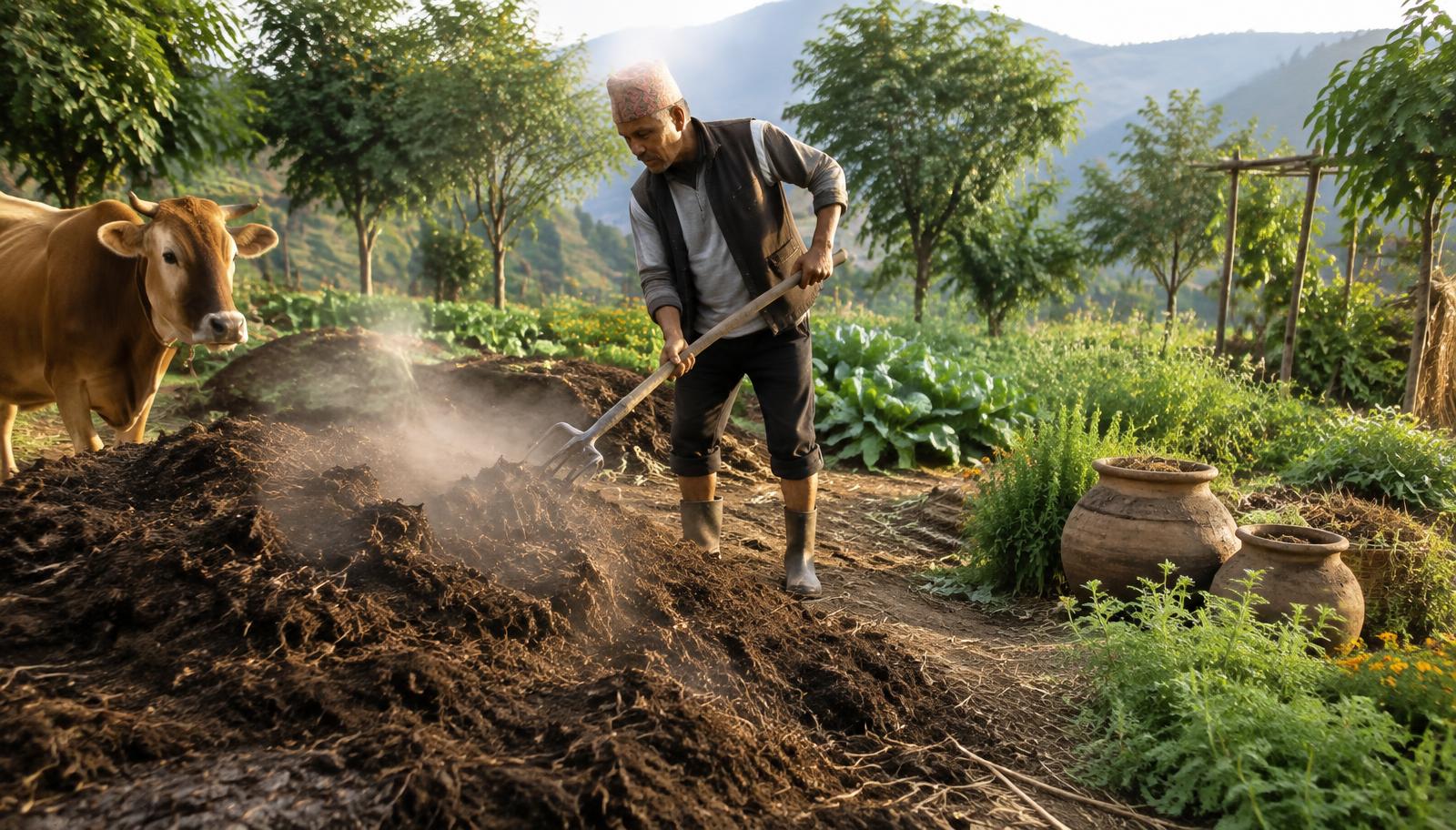
Compost is the foundation of the method. Carefully built and turned, it feeds the soil life that feeds the plants, improves the soil's structure and its capacity to hold water through the dry season and the monsoon. Spiral Farm House already produces around fifty tonnes of compost a year. As the network grows, compost production must grow with it — towards several hundred tonnes a year — so that organic fertility never becomes the bottleneck of the farms.
3.Preparations and rhythms
Biodynamics adds specific preparations, made from plants, minerals and manure, used in very small quantities on compost and fields to stimulate soil life and plant growth. It also pays attention to the rhythms of seasons and of the moon when sowing, planting and harvesting. These practices meet a long tradition in Nepalese rural life, where farming calendars and festivals have always followed the sky and the seasons.
4.Meeting Tharu knowledge
The Tharu people of the Terai have farmed their land for generations, with deep knowledge of seeds, soils, water, animals and plants. At Spiral Farm House, biodynamics did not replace this knowledge: it gave a framework to value it, test it and transmit it. The method BFS spreads is therefore not imported from abroad; it is a meeting between international organic practice and the indigenous knowledge from which the model grew.
5.Healthy soils as the farm's capital
For a Buddha Food System farm, the soil is the most valuable asset. A living soil produces steadily, resists drought and heavy rain better, needs fewer purchased inputs and stores carbon. Soil health is monitored farm by farm, because it underpins both the farmer's future income and the environmental results the network reports to its partners.
6.Why it matters for the network
Biodynamics lowers costs by replacing bought fertilisers with fertility made locally, reduces dependence on imports, and protects farms against climate shocks. It also creates a shared need — compost, preparations, seeds — that the network organises together and that can grow into local value chains. And it gives buyers a credible, verifiable story of how their food was grown.
Related: Agroecology · Bio-intensive market gardening · Spiral Farm House · Climate & carbon · Procurement