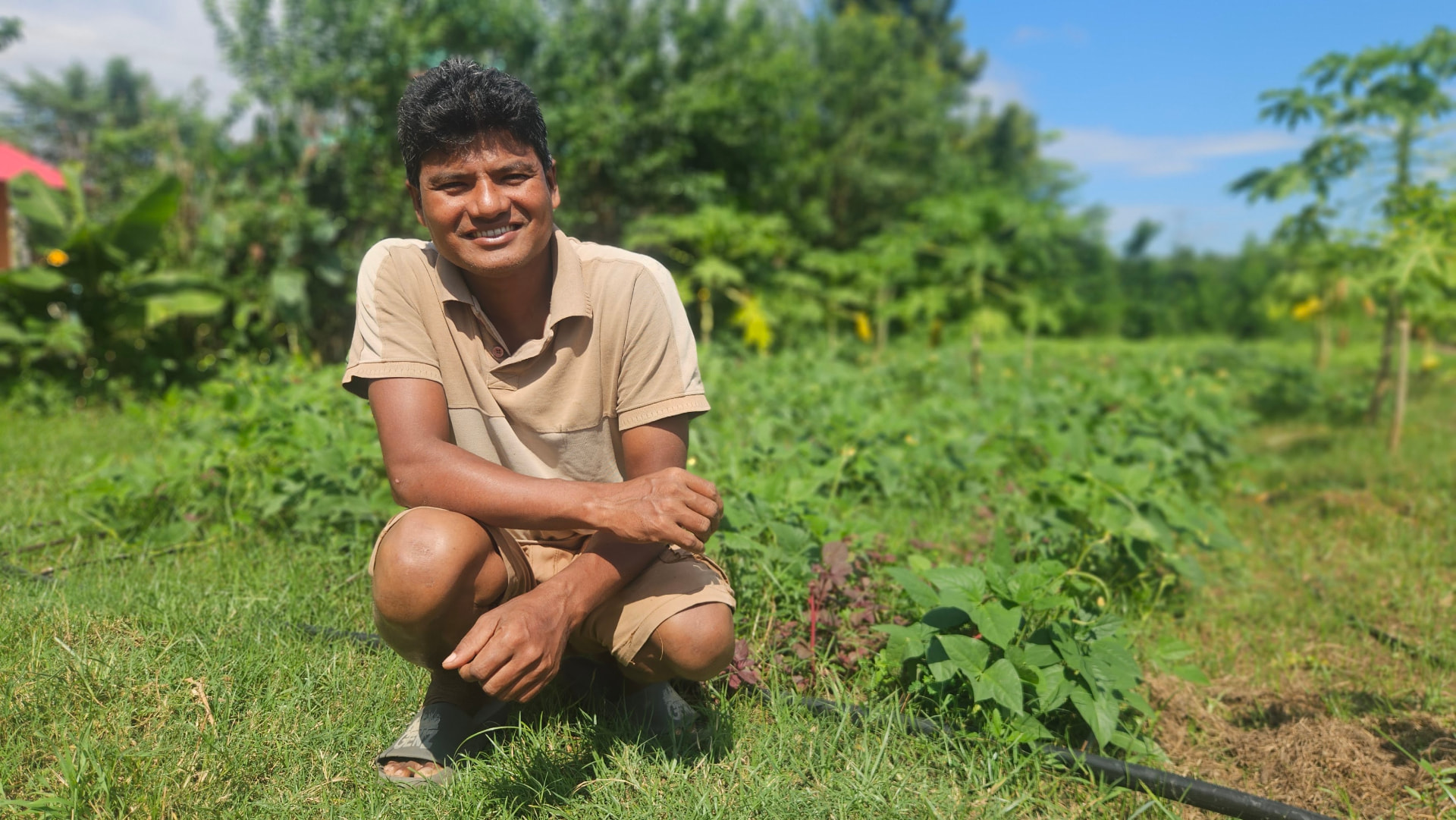
Before Buddha Food System had a name, there was a farm. Spiral Farm House was founded in 2013 by Sudarshan Chaudhary in Saptari, in Nepal's Madhes Province. It is a biodynamic organic farm and a training site, where the practices that BFS now wants to spread across a whole network were first tested in real conditions.
1.A farm and a school
Spiral Farm House was never only a place of production. From the start it has also been a place of learning, where farmers from the region come to see, try and adopt biodynamic and organic methods: living soils, compost, crop associations and careful use of water.
2.Inside the farm
I · The nursery
Every plant is raised before it is planted.
Nothing goes straight into the ground. Tomatoes and eggplants start in the nursery, in pots, under a bamboo shade house. This is the approach Jean-Martin Fortier describes for intensive market gardens: raise strong transplants in a controlled space, pot them up into bigger containers so the roots never get cramped, and send them to the field only when they are vigorous. The plant gains weeks, the bed is busy for less time, and the risk of losing a crop at the fragile seedling stage almost disappears.
A strong plant at transplant is half the harvest already secured.
II · The field
Permanent beds, water at the root.
In the field, the beds are permanent and each one carries its drip lines. Water and nutrients go exactly where the roots are, the soil is never left bare for long, and the transplants from the nursery take over a bed that is ready for them. The result shows in the cauliflower: even, dense and healthy. The clip below, filmed a few days after these photographs, shows the same crop standing in the field.
3.Recognised beyond Nepal
In 2016, Spiral Farm House was selected among the "100 projects for the Climate" by the French Ministry of Environment. Its founder represented Nepal's indigenous peoples at COP21 in Paris and COP22 in Marrakesh, and presented biodynamic farming in Nepal at the 19th IFOAM Organic World Congress.
4.The field roots of Buddha Food System
Sudarshan Chaudhary is today a co-founder of Buddha Food System, leading field operations and farm data. The experience of Spiral Farm House — growing, training and working with local communities — is the practical foundation on which BFS builds its farm package, its training path and its agronomic standards.
5.What it brings to the network
For BFS, Spiral Farm House is proof that organic methods work on a small Nepalese farm, and a place where future farmers and trainers can see the model before they run it themselves. Its exact role in the network — demonstration farm, training centre or first cluster — will be confirmed as the rollout is organised.
Related: Vision · New education system · Team