
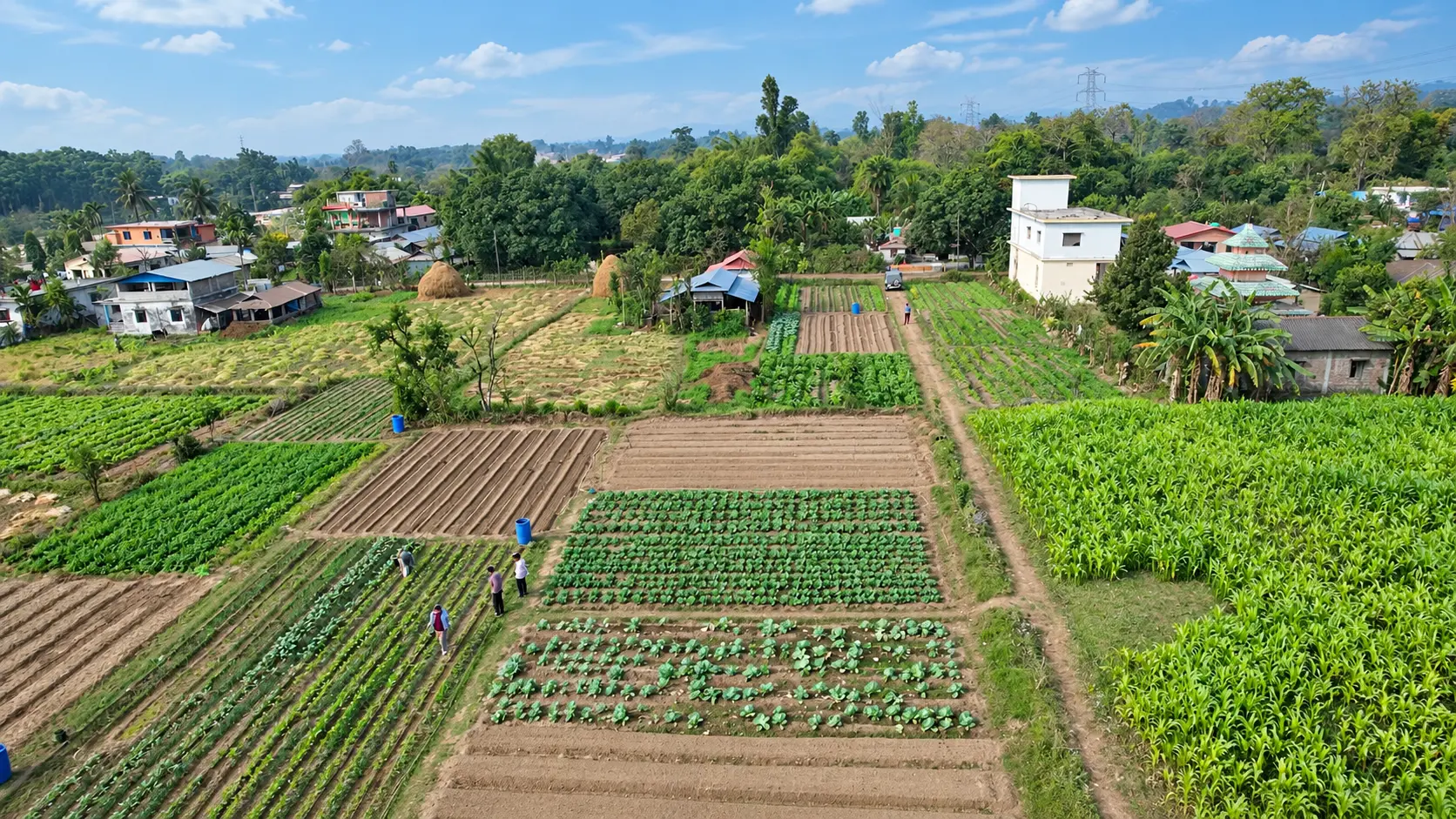
Nepal is a country of small farms. Most families still live from agriculture, on plots of a few hundred square metres to a hectare. Yet the country imports a growing share of its food and most of its chemical fertilisers, soils are losing fertility, and young people leave the villages for the cities or for work abroad. Farming is too often seen as the job of those who had no other choice.
Buddha Food System (BFS) starts from the opposite conviction. A small, well-designed organic farm can be a productive, profitable and dignified enterprise. And if it can be standardised, measured and reproduced, it can become an asset that capital is willing to finance — not with permanent subsidies, but with investment. The condition is to build, around the farmer, everything that does not yet exist in Nepal.
1.The Nepalese context
Nepal needs farming models that improve rural incomes and food security while reducing dependence on imported chemical inputs, and restoring soils, biodiversity and resilience to a changing climate. The Government has made organic farming and local compost production a national priority, but the transition cannot rely on good intentions alone.
Smallholders face a chain of obstacles. A farmer may be trained but lack the capital to build an efficient farm. Capital may pay for irrigation or a greenhouse, but it does not create the skills to run them. More production creates little value without reliable buyers. And banks cannot lend to farms whose harvests, revenues and repayment capacity remain unpredictable.
2.The real challenge: everything has to be built
A small organic farm that produces tens of tonnes of food a year is not a dream. It rests on three things together: know-how — agronomy, crop planning, soil fertility; the right attitude — rigour, discipline, the habit of doing things well every day; and the right equipment — irrigation, nursery, greenhouse, tools, compost, which means investment. Remove one of the three and the farm falls back into subsistence.
In Europe or North America, a market gardener takes the surroundings for granted. Buying good compost, a proper rake, organic fertiliser, quality seed, drip irrigation or a spare part is a matter of a phone call or a trip to the nearest shop. Training exists, advisers exist, banks know how to lend to a farm, buyers know how to order from it. In Nepal, almost none of this exists. Good compost is hard to find in volume, adapted tools are rarely sold, organic inputs are scarce, quality equipment must often be imported, and there is no established path from training to a financed farm to a reliable buyer.
This is why good intentions and training alone have not changed Nepalese farming. A farmer cannot build, alone, the whole world that a Western farmer finds ready around him. The missing piece is not the farmer: it is the infrastructure around the farm.
Buddha Food System exists to build that infrastructure — a complete national value chain for organic food: training, compost and inputs, tools and equipment, shared infrastructure, planning, logistics, markets and finance, organised as one food system connected to national and global demand. Inside such a system, the farmer stops being the last wheel of the cart, the one who takes all the risk and keeps the least value, and becomes a skilled entrepreneur at the wheel of a high-performance machine.
3.Roots in Tharu indigenous knowledge
The model was born in the Terai, within the Tharu indigenous community. Since 2013, Tharu farmer-entrepreneur Sudarshan Chaudhary has developed Spiral Farm House: about one hectare of bio-intensive organic farming, drawing on agroecology, regenerative and biodynamic practices, and the traditional agricultural knowledge of his people. Over more than a decade, the farm has shown that a small organic farm can feed a family, generate substantial recurring revenue and restore the soil instead of exhausting it.
4.From one farm to a replicable model
A single successful farm is an exception. The real question is whether other farmers can reproduce it. Between 2024 and 2026, an R&D phase translated the Spiral Farm House experience into a standard farm: its design, infrastructure, equipment, labour, operating processes and economics, and the shared services it needs around it.
This made it possible to describe one ready-to-operate farm as a clear investment unit, whose cost and performance can be measured and compared from one farm to the next.
5.Grid farming: diversity at farm level, scale at network level
Organic agriculture is usually scaled by building bigger farms, which often means monoculture. BFS does the opposite. It connects many small, diversified farms into a coordinated network — the grid. Each farm stays small, diverse and owned by its farmer; what is too expensive or too complex for one farm is organised together: crop planning, procurement, compost, equipment and maintenance, post-harvest handling, logistics and access to markets.
Market access is part of the design from the start. Farms sell locally, directly to nearby consumers through the Magic Organic app and local markets, and together to larger buyers in the cities, processors and international markets.
6.Growing farmers, not only crops
The first bottleneck is human. Capital, infrastructure and a short training are not enough to create a successful farm. BFS trains future farmer-entrepreneurs by letting them learn inside the productive system they will later run: organic practice, soil fertility, crop planning and equipment on one side; costs, cash, customers and quality on the other. The farmer brings no money upfront: the farm package, including the first year of salary, is repaid from sales, and the farm then belongs to them.
7.An ecosystem, not a single organisation
BFS does not intend to own every part of the system. As the grid grows, it creates predictable demand for compost, irrigation, adapted small tools, greenhouses, storage, processing, logistics and finance. Indigenous organisations, public institutions, Nepalese manufacturers and startups, established agricultural companies and financial partners can each develop the part that matches their role. The grid's job is to make these pieces work together.
8.From grants to investment
Grants should not finance every new farm. Their role is to prove the model and pay for public goods — training, soil restoration, indigenous knowledge. Once replicated farms show consistent results, an independent financial partner can assemble portfolios of farms, blending first-loss protection and guarantees, patient equity and bank debt, each taking the risk it can bear. One farm is too small for an investor; a portfolio of a hundred or a thousand farms is not.
9.Open, and built to travel
The model comes from Tharu experience but is not reserved to it. Its standards, training methods and economics are documented in an open spirit, so that other indigenous peoples, other Nepali communities and, one day, farmers in other developing countries can learn from it, challenge it and adapt it — while keeping agricultural progress connected to the culture it grew from.
Related: Presentation · Spiral Farm House · Agroecology · New education system · Financial engineering