
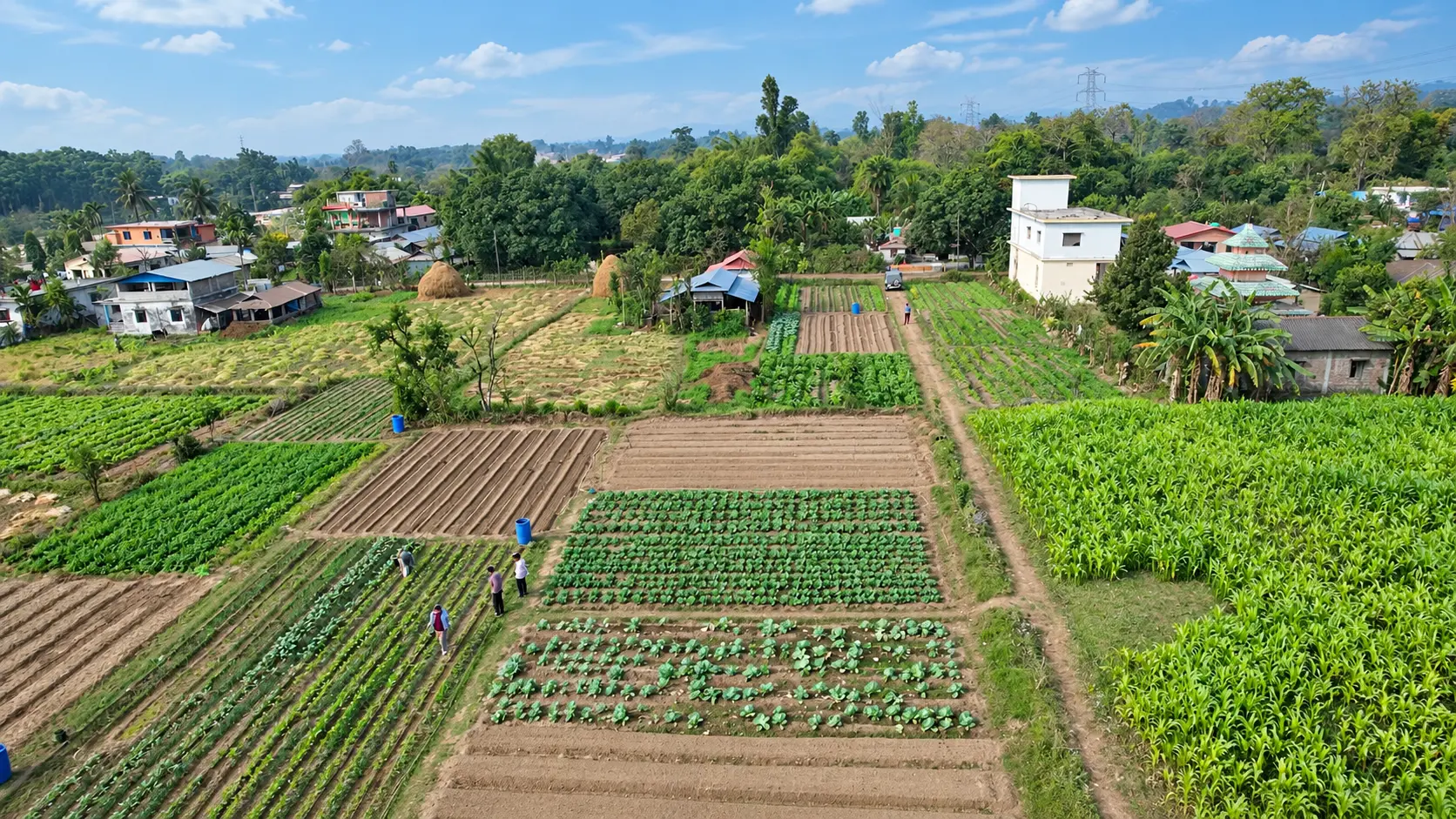
Buddha Food System (BFS) is an agricultural operator that plans, finances and supports a network of small, independent organic farms in Nepal. Between 2024 and 2033, the model foresees the opening of 1,100 farms, run by 3,300 farmers on some 1,650 hectares, organised into 220 local cooperative clusters (L1) and 55 regional clusters (L2). Each farm is launched with a package of €15,000, financed through blended finance portfolios raised by an investment fund and entrusted to BFS as a single operational package.
The overall objective is to show that thousands of smallholders can be financed, trained and connected to national and international markets without losing ownership of their land or their business, and that the wealth created by the system returns first to those who produce it.
More specifically, the model aims to deliver three results: a repeatable financing unit, the farm package, that investors can buy by the batch; a shared infrastructure whose cost is carried by farms in proportion to their use and repaid through a single cascade; and a standardised set of performance indicators, from farmer income to soil carbon, that makes every portfolio comparable and auditable.
1.Why Buddha Food System
Nepalese agriculture rests on millions of family plots. They are too small to buy modern tools, too scattered to negotiate with buyers, and too risky for banks. Young people leave the villages, soils lose fertility, and most of the value of food is captured far from the farm.
Buddha Food System was created to reverse this logic. It does not replace farmers: it gives them what a large farm has, planning, equipment, agronomic expertise, procurement and market access, while keeping each farm a small independent business. Farmers are trained in the BFS school in entrepreneurship and in bio-intensive organic market gardening, a practice still new in Nepal.
2.What is genuinely new
Smallholder finance already has well-known models. Each solves part of the problem and leaves another part open. Grid farming combines their strengths in a way none of them does alone.
| Model | What it does well | What it leaves open | How grid farming answers |
|---|---|---|---|
| Agricultural cooperative | Pools sales and shares margins | Little capital, weak planning, risk shared by all members | Capital arrives with the farm; one operator plans for the whole network |
| Contract farming / outgrower scheme | Secures a buyer and inputs | Farmer depends on one buyer and captures little value | Two offtake channels, and 50% of BFS net profit returned to farmers |
| Microfinance | Reaches individual farmers | Small, short, expensive loans; no market access or equipment | A full, long-term package with equipment, training and markets included |
| Large commercial farm | Scale, technology, efficiency | Concentrates land and wealth | Scale of a large farm, ownership of thousands of small ones |
Four features make the model new:
- Investment and operations are separated. A farm repays its package over a fixed period; the running of the system is paid by a single cooperative commission. Investors can read each flow on its own.
- One debtor, many assets. Only the farm carries debt, including its share of the shared L1 and L2 infrastructure. When farms repay, the clusters are repaid automatically, with no debt between clusters.
- Central planning, distributed ownership. BFS plans the network as one farm, while every plot remains a farmer-owned business.
- A wealth-sharing commitment written into the model. Half of BFS net profit, and a share of carbon revenues, go back to farmers by design, not by goodwill.
3.The grid farming model
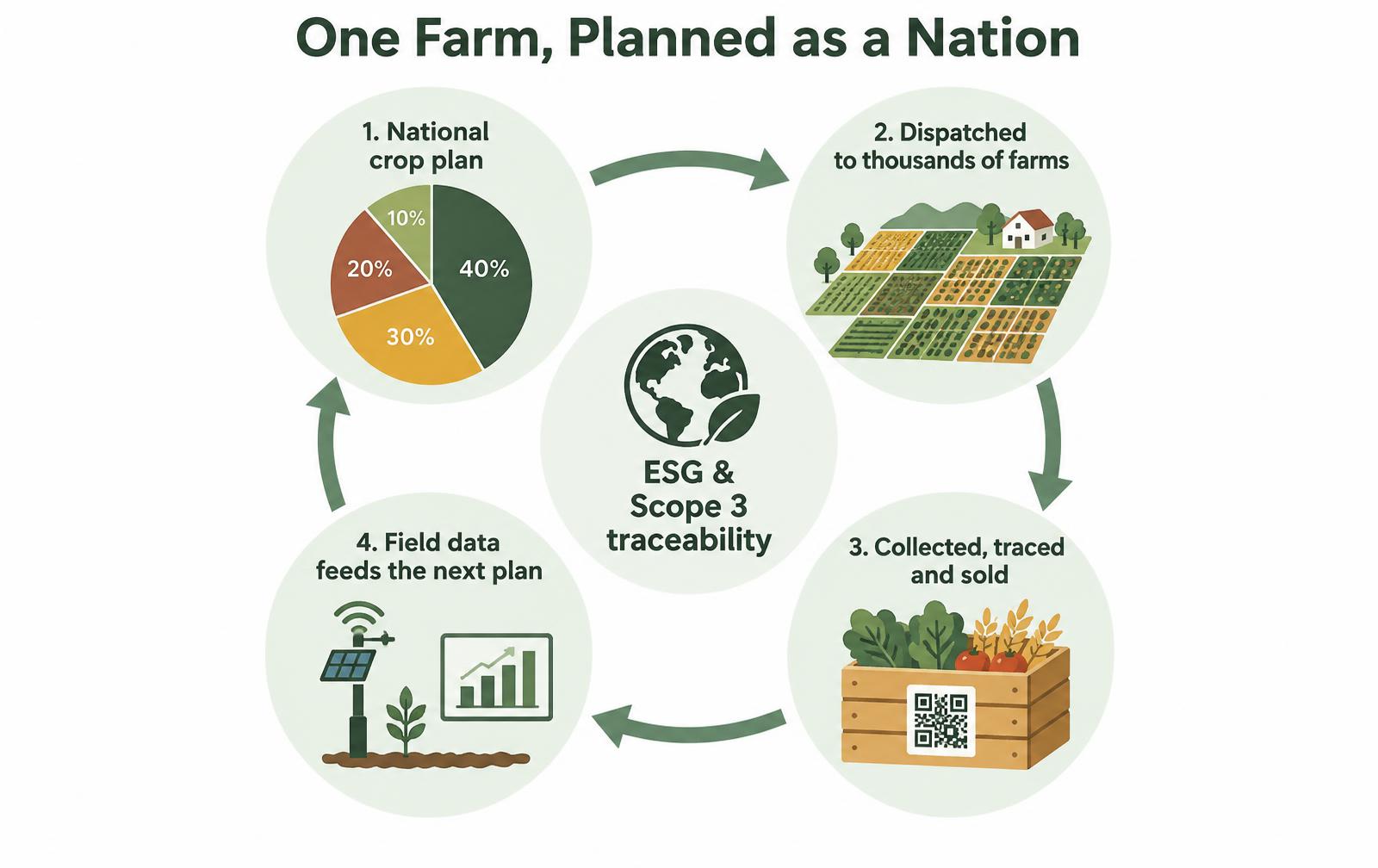
Grid farming means managing thousands of small farms as a single, coordinated production system. BFS defines the national crop plan: in the current scenario, 20% cash crops (cosmetic plants), 17% tomato, 23% eggplant, 20% leafy greens, 20% other vegetables. Each farm grows its share of the plan, which spreads risk, avoids local overproduction and secures volumes for buyers. Data collected on every farm, yields, soil condition and sales, feeds the next season's plan.
Farms are grouped geographically. About 5 neighbouring farms share a local cluster (L1), and about 4 L1 clusters share a regional cluster (L2), that is 20 farms per L2. No cluster size is fixed: the model can be replayed with any network shape.
4.Roles and responsibilities
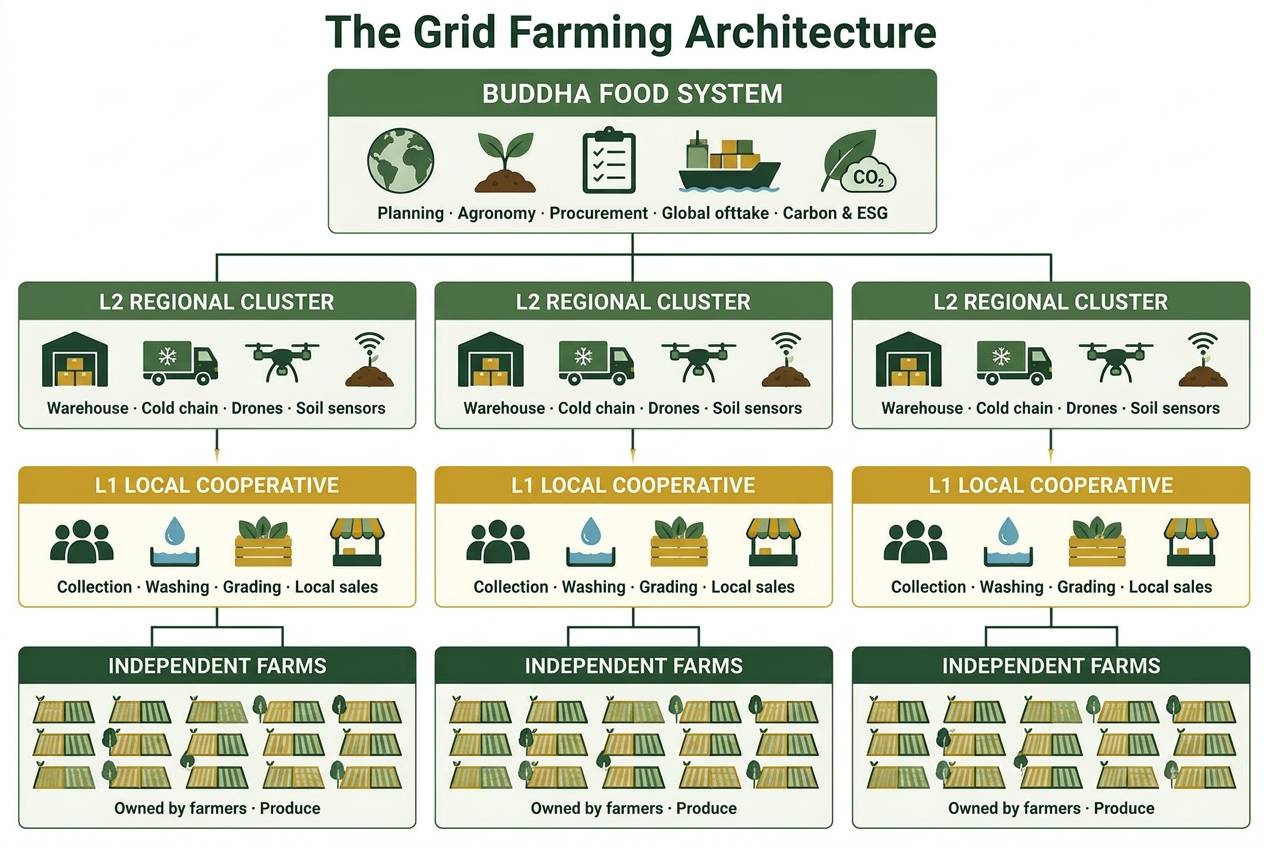
Each level of the system has one clear role and its own business model. Each is a separate company within the BFS group.
- The farm produces. It owns its tools and sells its whole harvest through the system.
- The local cluster (L1) is a cooperative. It collects, washes, grades, packs and sells vegetables on local markets, and lives from a commission on farm sales.
- The regional cluster (L2) runs long-term infrastructure: warehouses, cold chain, drones and the sensors that measure soil carbon on every farm.
- Buddha Food System plans production, manages agronomy and national procurement, signs the large offtake contracts, transforms products such as essential oils, and carries the carbon and ESG reporting.
The rule is simple: whoever produces a product or carries its commercial risk records the sale; whoever only connects actors earns a commission or a fee.
5.Blended finance architecture
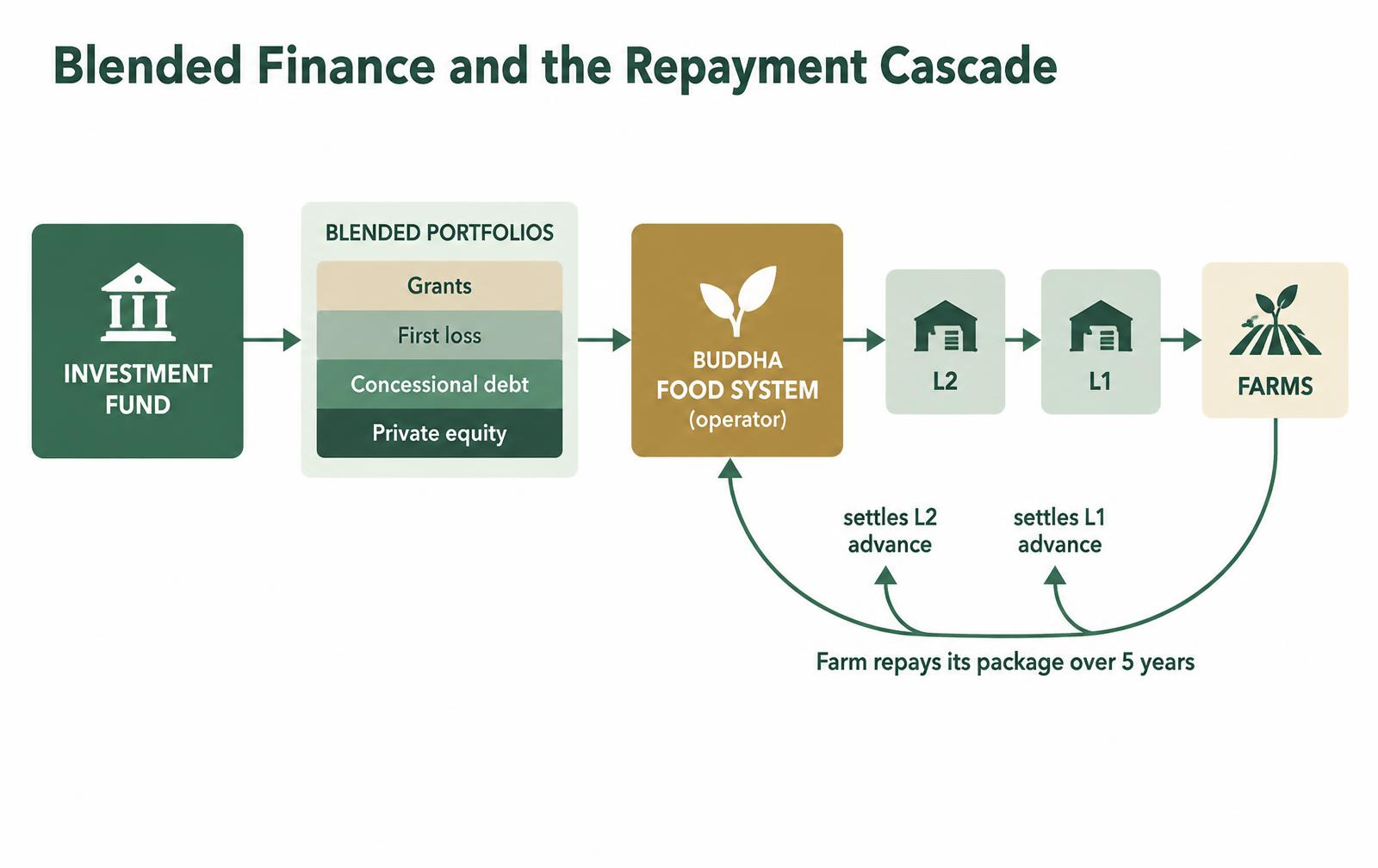
An investment fund structures portfolios that finance batches of farms, for example 50 farms at €15,000 each. Each portfolio blends grants, first-loss capital, concessional debt and private equity. The blended package is then entrusted to BFS, whose only role is operational: deploying the money, launching farms and clusters, and running the system.
BFS provides each L1 and L2 with what it needs to start: 20% as equity, which keeps the group in control, and the rest as a long-term advance. Assets are recorded in the company that uses them, the warehouse in the L2 and the central building in the L1, so BFS remains an operator rather than a property company. In the current scenario, the peak funding need of the whole system is €328,053.
For the full structuring (capital layers, loss protection, insurance, public guarantee and portfolios), see Financial engineering.
6.Why blended finance is needed
Blended finance is used only where private capital would not come on its own. Three gaps justify it:
- The start-up gap. L1 clusters are built before their farms produce, and farms need a year to reach full production. Grants and first-loss capital cover this period, including the farmers' guaranteed income.
- The tenor gap. Buildings and warehouses last 10 to 15 years, far longer than commercial loans available to smallholders. Concessional debt matches the life of the assets.
- The perception gap. Lenders see smallholders as too risky. The model gives them a track record, farm by farm, batch after batch, until commercial capital can take over.
The concessional layers are designed to shrink over time: as repayment data accumulates, each new portfolio should need a smaller share of grants and first-loss capital.
7.The farm package and its repayment
Each farm receives a package of €15,000. It covers €0 of its own equipment, irrigation, greenhouses and tools, and its contribution to the shared infrastructure of its L1 (€0) and of its L2 (€0). The full cost of one farm in the network is therefore €0, compared with €0 for a farm that would have to buy all this equipment alone.
The farm repays its package to BFS over 5 years, after 1 year(s) of grace, at 3%. Only the farm carries debt. As it repays, the part of each instalment that corresponds to its contribution settles the advances made to its L1 and L2. When all farms have repaid, all clusters are implicitly repaid too: in the current plan, the last farms finish repaying in 2038.
8.The cooperative commission and the cascade
The investment repayment and the running of the system are kept strictly separate. To run the system, the L1 cooperative takes a commission of 15% on farm sales. This single commission already includes the share of the L2 (20% of the commission) and of BFS (20%), passed on in cascade.
Once its package is repaid, a farmer pays only the cooperative commission, and nothing else, ever. An L1 needs about 5 active farms to cover its own costs, and an L2 about 51. Below these thresholds, a cluster is under-used, which is the main operational risk; above them, each additional farm improves its margin.
9.Offtake channels
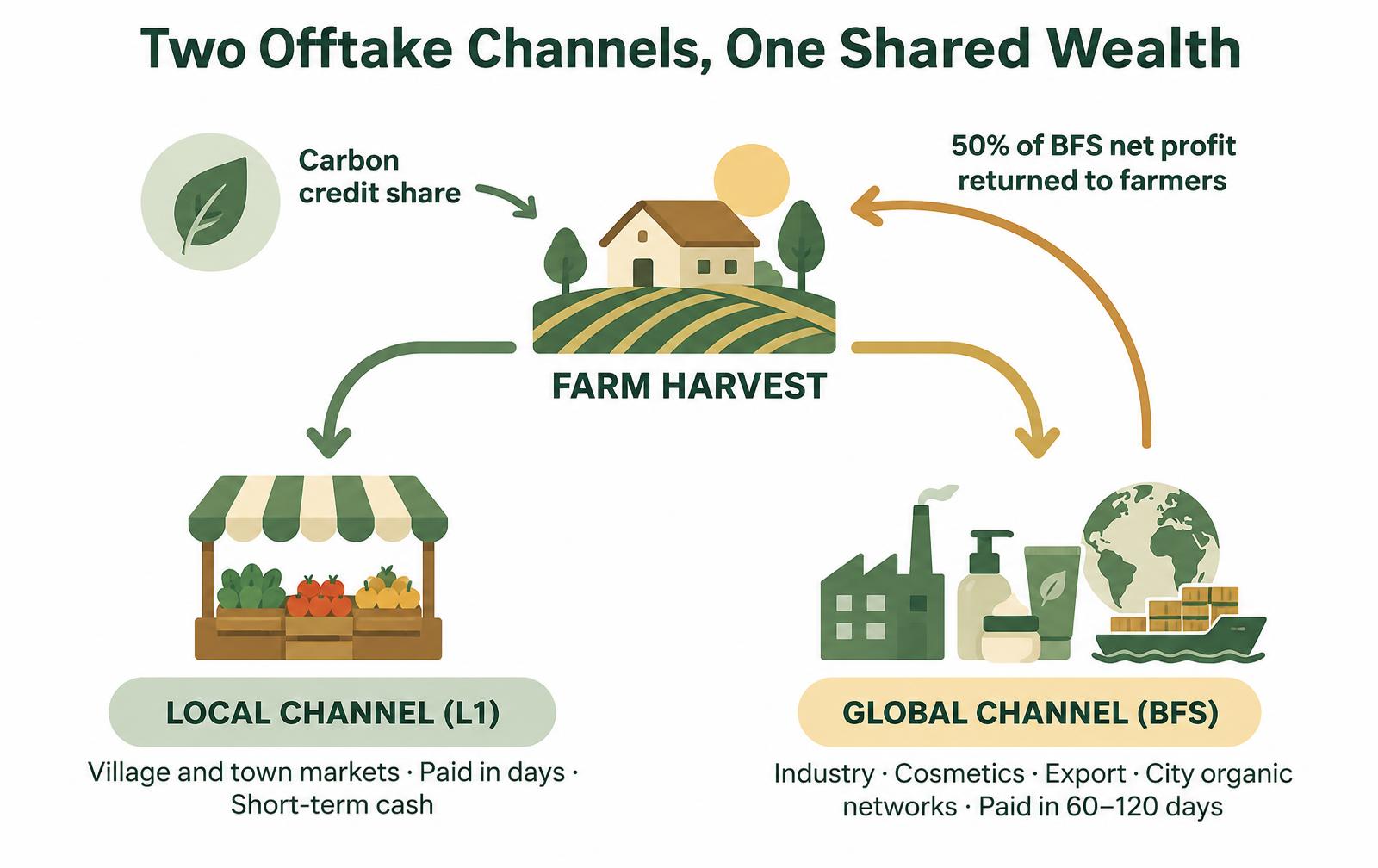
All harvests are sold through two offtake channels. The local channel, run by the L1, sells vegetables in nearby towns and villages; it is paid within about 7 days and gives farmers short-term cash. The global channel, run by BFS, supplies food and cosmetic industries, organic networks in large cities and export markets; it pays better, but in 90 days or more.
To protect local food security and farmer cash flow, at least 40% of production is sold locally; in the current plan the local share is 71%. Crops mainly sold on the global channel include cash crops (cosmetic plants) and other vegetables. BFS pays farmers at delivery and carries the waiting time of global buyers itself.
10.Shared wealth
Enrichment must benefit farmers. BFS pays farmers the farm-gate price for the produce it sells globally, and then redistributes 50% of its net profit to farmers, in proportion to what they delivered, once its past losses are covered. Over the modelled period this represents €3,073,031. BFS keeps the other half to grow and to remain a solid company.
Soil carbon follows the same principle. BFS carries the carbon programme at national level; 50% of carbon revenues go to farms, 10% to the L2 for measurement, and 40% to BFS for certification and reporting.
11.Governance and exit
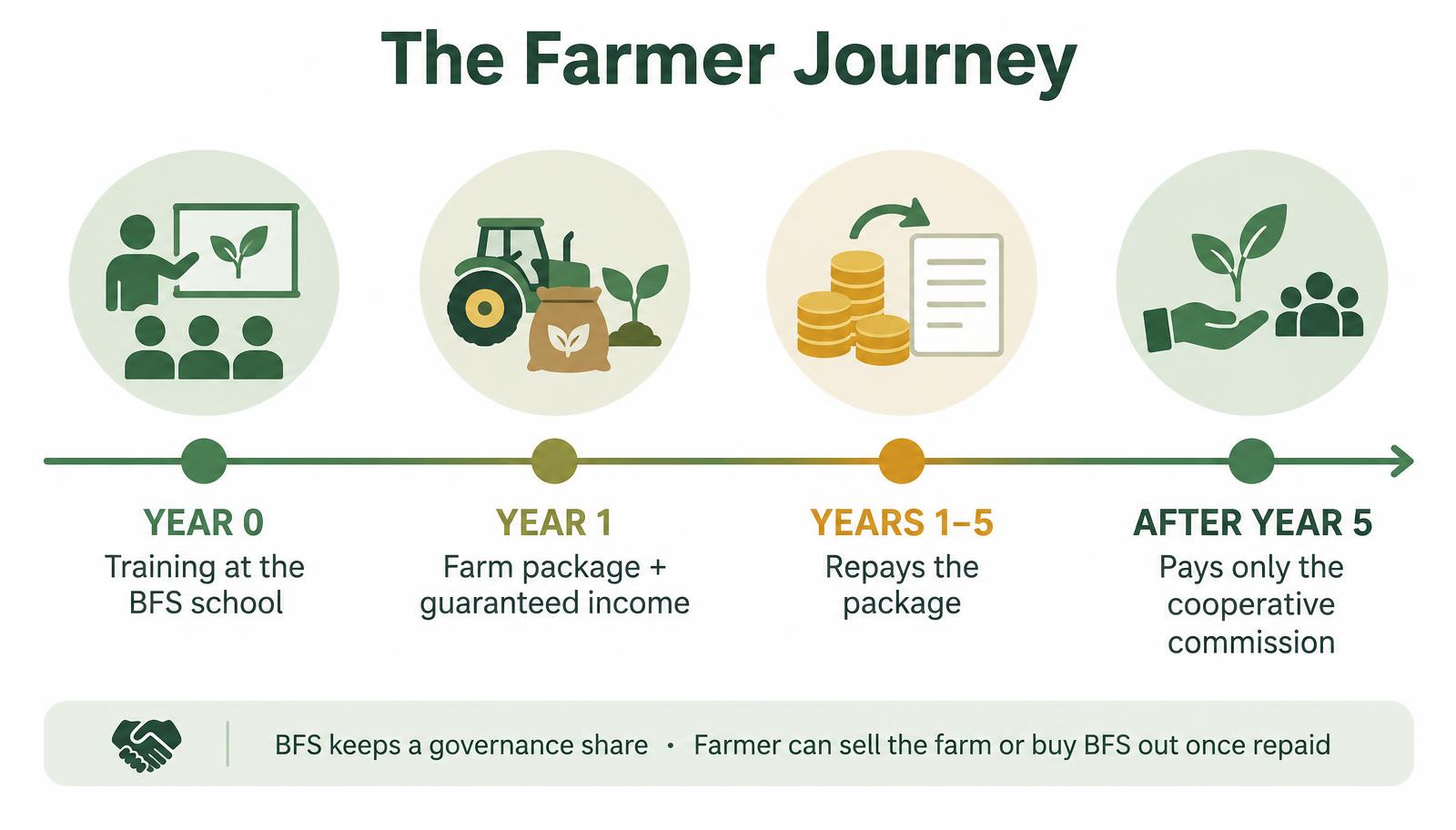
BFS keeps a small governance share of 10% in each farm, with no right to its profits. It guarantees that the farm follows the crop plan, organic practices and traceability standards. The farmer remains the owner. Once the package is repaid, the farmer may sell the farm to another farmer who accepts the same standards, or ask BFS to leave for a symbolic €1. By default, BFS stays: supervision is kept, exit is free, and the cost is limited.
12.Risk allocation
Each risk is carried by the party best placed to manage it.
| Risk | Who carries it | How it is mitigated |
|---|---|---|
| First-year income of new farmers | Grant / first-loss tranche | Guaranteed income of €1,200 per farmer, not repaid |
| Farm default on the package | First-loss tranche, then BFS | Training, crop plan, grace period, local cash channel |
| Under-used L1 or L2 | BFS as shareholder | Clusters opened only with enough farms; sites rented with an option to buy |
| Price and overproduction | BFS | National crop plan and diversified buyers |
| Late payment by global buyers | BFS | Farmers paid at delivery; minimum local share |
| Climate and crop loss | Farm, then insurance | Crop diversity, protected cultivation, future income insurance |
13.Returns for each class of capital
Each class of capital is paid from one clear source, so that no investment is repaid twice.
- Grants and first-loss capital are not repaid. Their return is impact: farmers financed, income created, carbon stored.
- Concessional and commercial debt is repaid by the farm packages, principal and interest, through BFS.
- Private equity in BFS is paid only from the operating profit of the system: global offtake margin, processing, carbon and ESG services, and the BFS share of the cooperative commission. It never recovers again the investment already repaid by farms.
L1 and L2 are neither cash cows nor liabilities: they are amplifiers. Their costs are mostly fixed and their revenues grow with the number of farms. Their value to the group comes from their operating result once past break-even, not from the recovery of their buildings.
14.Scale and replication
The farm package is a standard unit: same content, same contract, same indicators. A portfolio is simply a number of packages, with the L1 and L2 they need. This makes the model replicable from valley to valley, and later to other countries with similar smallholder structures.
The network grows from 1 farm(s) in 2024 to 1,100 in 2033. The same model, the same tables and the same indicators are used at every step, so that the first farm and the thousandth are measured in the same way.
15.Impact and ESG indicators
The model follows a standard set of indicators: number of farms and farmers financed, hectares under organic management, net income per farmer (€1,543 in 2033 in the current scenario), share of food sold locally, repayment rate, tonnes of carbon stored in soils, and value redistributed to farmers.
Because BFS plans, collects, transforms and sells, it can trace every kilogram from the field to the buyer. This gives industrial partners reliable ESG data, including on scope 3 emissions, the hardest part of their supply chain to measure. The indicators are designed to be mapped onto the frameworks investors already use for impact reporting.
16.Transparency
Every figure in this presentation comes from the same model: the budget of each farm and cluster, the profit and loss statement of the four companies over ten years, the cash flow, the flows between companies and the monthly records of real sales and purchases. Past years are shown as actuals, future years as forecasts. Every assumption, from the commission rate to the crop plan, can be changed and its effect seen across the whole system.
This transparency is the foundation of trust between farmers, BFS and the investors who finance them.