
The challenge is not to find a funder willing to pay for one farm. It is to turn a standard farm into a repeatable investment unit, and then to gather these units into portfolios whose risk is measured, diversified, insured and partly guaranteed.
Three principles run through this page. Buddha Food System operates; an independent partner finances. Each risk is carried by the actor best placed to carry it. And public or philanthropic money does not replace private capital: it absorbs the costs and risks the market cannot yet carry, so that every catalytic euro mobilises several commercial euros.
1.Two companies, two jobs
The architecture rests on a clear separation of functions. Operating farms and structuring finance are two different trades, and each is entrusted to a different company.
| Actor | Main function | Role in the model |
|---|---|---|
| Demonstration farm | Reference and R&D | Proves the agronomic, economic and climate model; produces the first data and trains farmers |
| Buddha Food System | Operator | Designs and deploys farms, trains, plans crops, aggregates, sells and measures performance |
| Independent financial partner | Financial interface | Structures debt, equity, guarantees and insurance; builds and manages several portfolios; reports to funders |
| Banks and investors | Capital | Finance farm assets and working capital |
| Guarantee and first-loss | De-risking | Reduce the expected loss and unlock credit |
| Insurers | Risk transfer | Cover climate, crop and asset events |
| Non-profit arm | Public-interest work | Training, local knowledge, biodiversity and grant-funded projects, kept contractually separate |
The financial partner is not an agricultural operator, and BFS is not a financial institution. BFS invests in the partner and supplies it with the operating data that makes each farm bankable; the partner speaks the language of banks, funds and insurers.
2.The capital layers of a farm
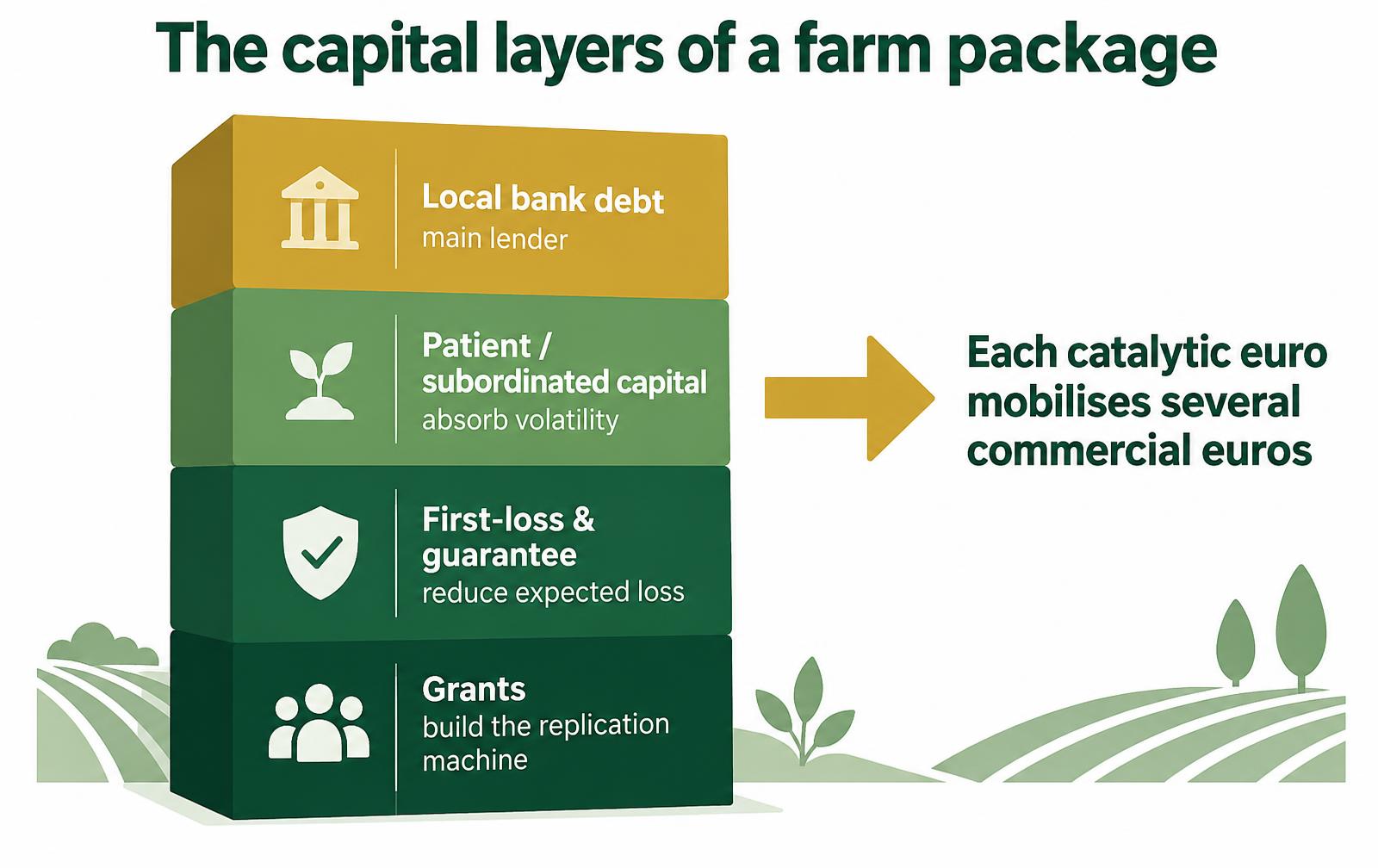
A farm package avoids two extremes: 100% grant, which does not scale, and 100% commercial debt from day one, which is too risky before a track record exists. It combines several layers, each with one job.
- Local bank debt is the main lender. Agricultural value-chain loans already exist in Nepal; the task is to fit their tenor, grace period and repayment to the farming cycle.
- Patient or subordinated capital absorbs volatility and completes the financing where bank debt stops.
- First-loss capital and guarantees sit alongside, reducing the expected loss for senior lenders.
- Grants finance the replication machine, not the farms forever: standard contracts, the data and scoring system, insurance design, technical assistance to banks and farmers, and the first cohorts where donor rules allow.
The farmer brings no upfront contribution: the package is carried by the layers above.
3.Who absorbs a loss, and in what order
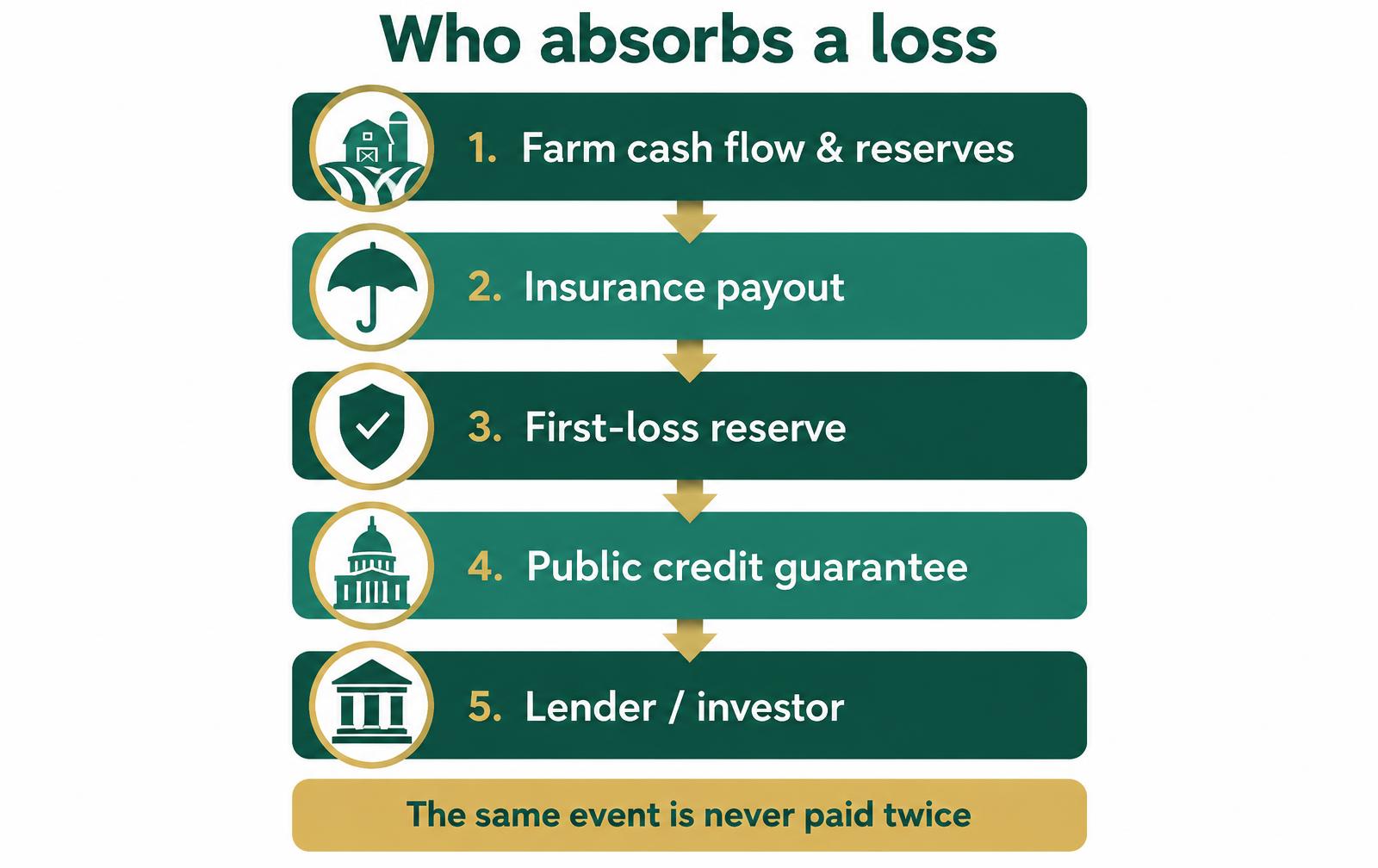
When a farm has a bad season, the loss travels through a fixed sequence of protections:
- the farm's own operating cash flow and reserves;
- an insurance payout, when a covered event caused the loss;
- the first-loss reserve of the portfolio;
- the public credit guarantee, on the eligible share of the loan;
- the residual loss, carried by the lender or investor under their contract.
The same event is never paid twice. The rules linking insurance, guarantee and first-loss are written into the contracts and agreed with each institution.
4.Insurance as a risk-transfer layer
Insurance is a risk-transfer layer, not a general guarantee of profitability. Each product answers a risk that can be objectively defined and proven, either by an index or by an assessment.
| Risk | Instrument | How it works |
|---|---|---|
| Excess rain, drought, heat | Parametric (index) insurance | Pays automatically when a weather index is crossed, with no field assessment after the event |
| Crop loss | Indemnity crop insurance | Needs defined crops, perils and insured yield, and an assessment |
| Pumps, irrigation, equipment | Asset insurance | Protects the financed assets |
| Death or disability of the farmer | Life / credit-life cover | Protects debt service and the family |
| Portfolio risk | Cover negotiated at portfolio level | Volume and standardisation lower the cost per farm |
What makes it work is data: the location and climate exposure of each farm, weather history, crop calendars, expected and actual yields, losses by cause and the value of insurable assets. Comparing the weather index with real losses keeps the gap between payout and damage small.
5.The public credit guarantee
Nepal is setting up a national agricultural credit guarantee scheme for smallholders, cooperatives and agri-SMEs, designed by the national deposit and credit guarantee fund with UN agencies. Such a scheme covers part of the loss a bank would suffer on a farm loan, which lowers the bank's risk and its price.
For BFS, the question is how successive cohorts of farms can enter the scheme, directly or through a partner bank, and under which geographic, sector and portfolio conditions. A guarantee does not replace good farms: it makes a proven model cheaper to finance.
Reference: UNDP Nepal, launch of the Agriculture Credit Guarantee Scheme (Joint SDG Fund initiative with UNCDF, FAO and WFP). To be confirmed before publication.
6.From one farm to a thousand: portfolios
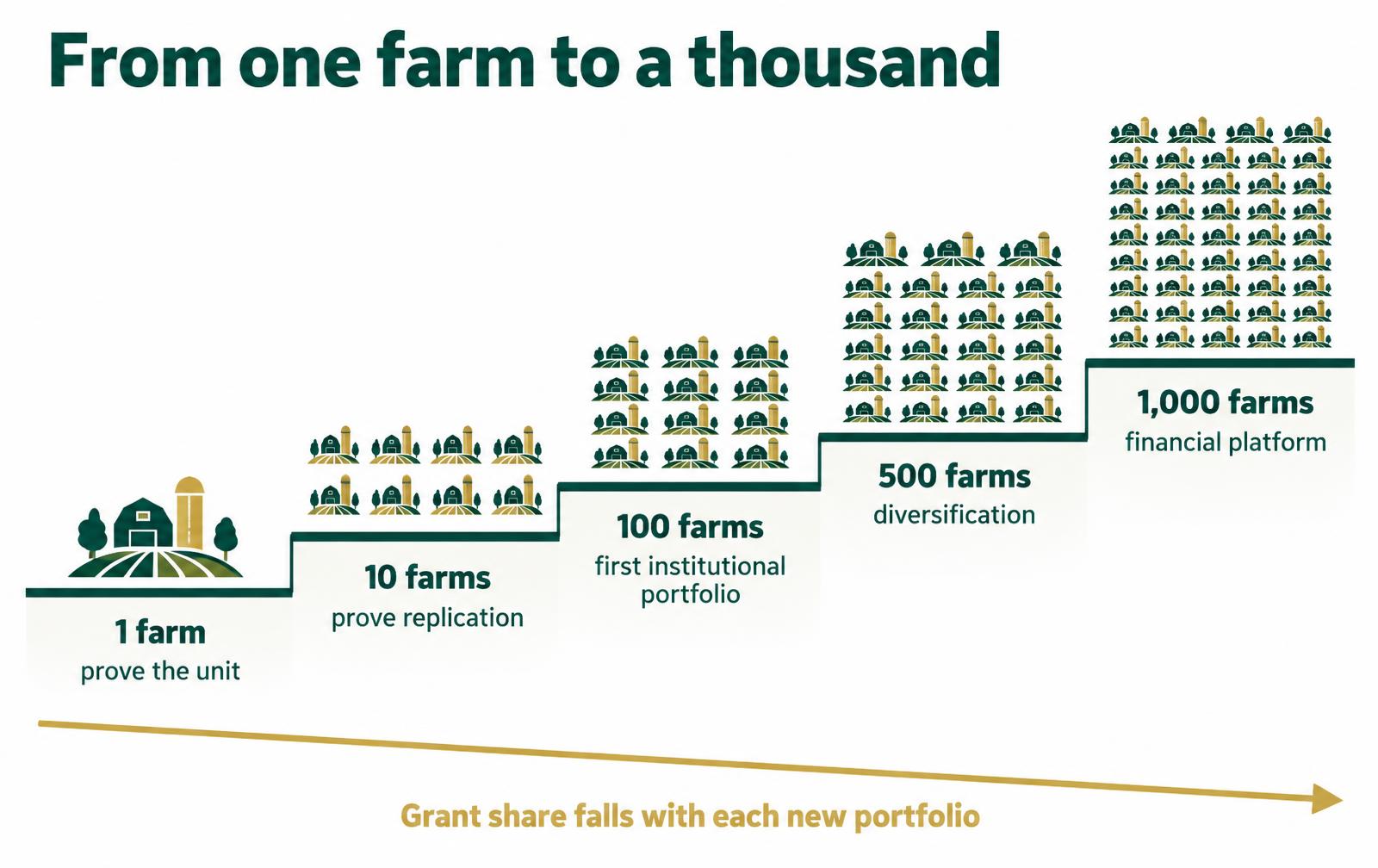
The value of the financial partner appears fully when farms are grouped. A portfolio shares due-diligence costs, standardises contracts and diversifies part of the risk of each individual farm.
| Scale | Financial objective |
|---|---|
| 1 farm | Prove the economic unit |
| 10 farms | Prove replication and processes |
| 100 farms | First institutional portfolio |
| 500 farms | Diversification and lower unit costs |
| 1,000 farms | A financial platform of significant size |
Each portfolio is diversified by river basin, crop family, planting and harvest dates, sales channel and farmer cohort.
Diversification has limits: a regional flood or a price shock hits many farms at once. These shared risks are the reason for insurance and guarantees. Several portfolios run in parallel, each at a different stage, and each new one needs a smaller share of grants and first-loss capital as the track record grows.
See the Presentation for the overall model, and Cash flow for the funding needs year by year.