
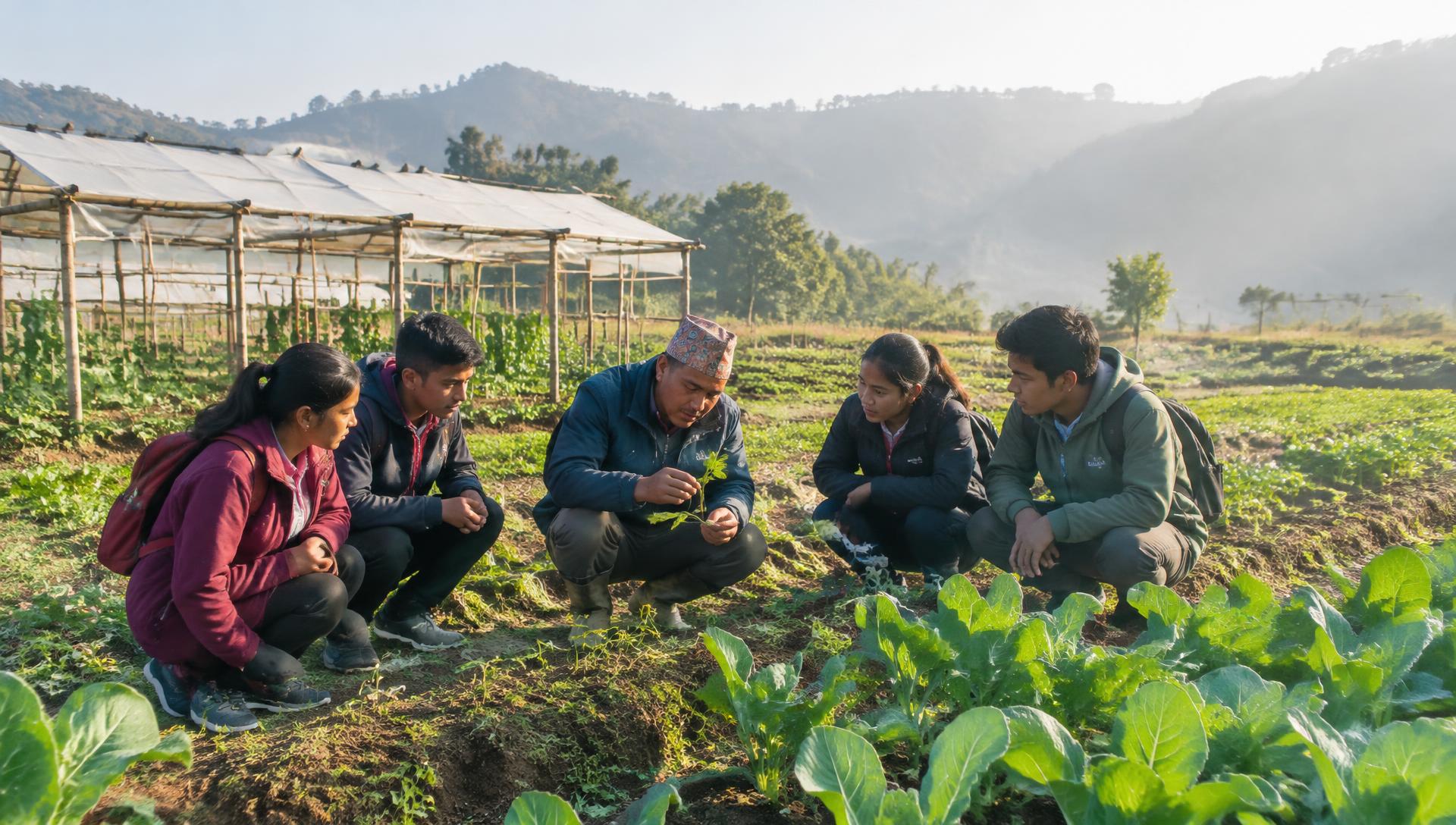
Scaling small, high-performing farms does not depend only on land, agronomic methods or finance. It depends on people able to run a productive asset with consistency, care, commercial sense and autonomy. Buddha Food System therefore treats education not as a social activity that comes before investment, but as the first part of the investment itself.
The path is free for every participant. It is designed as a mutual choice: the participant discovers the trade, and BFS gets to know the participant, season after season, before anyone is entrusted with a farm.
1.A new relationship to learning
A classic school teaches first and hopes for a job later. This path works the other way round.
- You learn by producing. Knowledge is built in the field, on real crops, with real consequences.
- You are judged on evidence, not on a diploma. What counts is what you do, repeatedly, over a full season.
- You earn your place while you learn. The food you help produce pays for your training.
- A real outcome waits at the end: your own farm, or a skilled role in the network.
2.The learning path
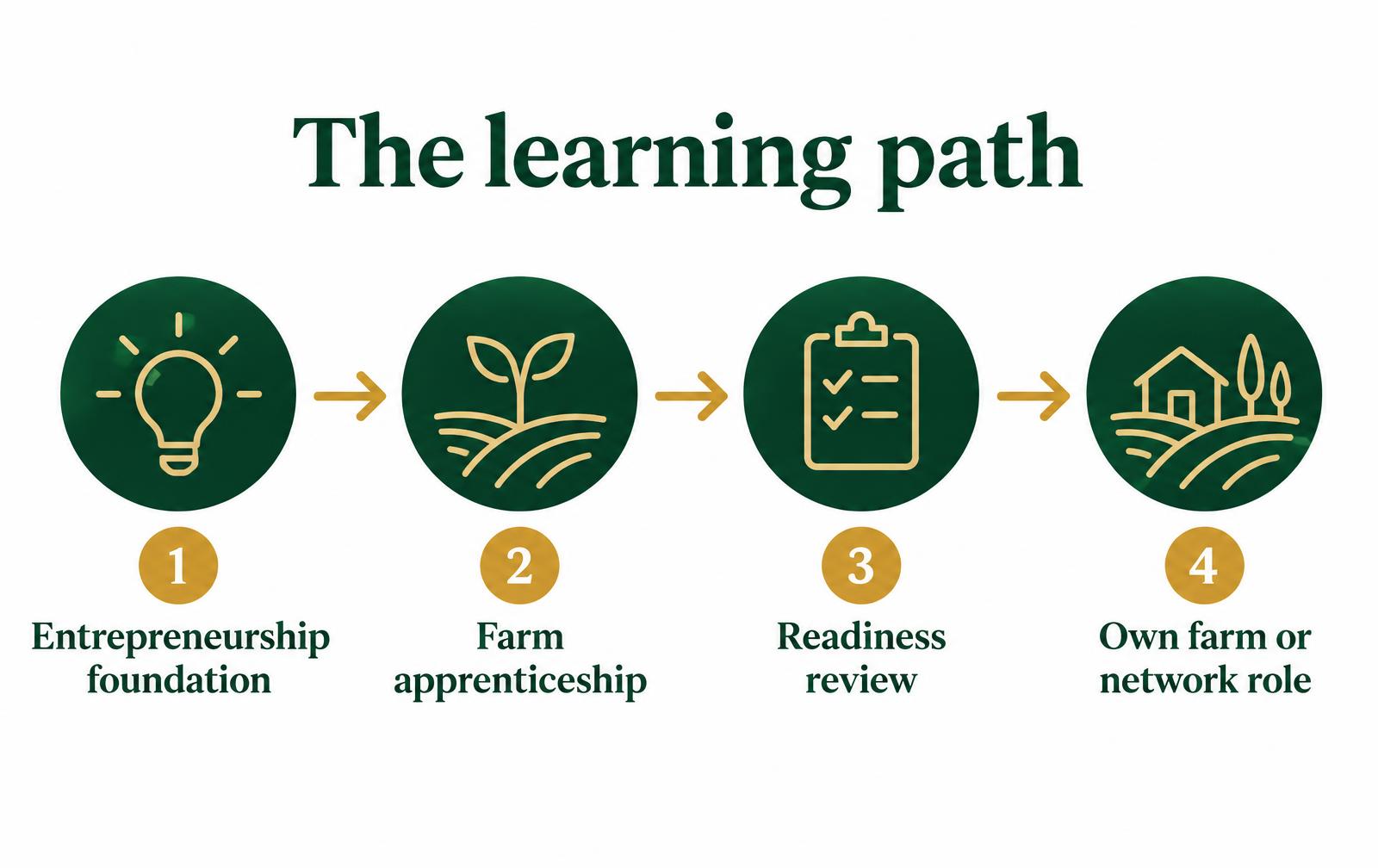
The path has four steps. Many people can enter the first one; fewer, more resource-intensive places are offered at each following step, to those for whom the evidence shows it is the right next move. Every transition is explained in advance and documented.
3.Stage I — the entrepreneurship foundation
The first stage is open to many candidates, from every region of Nepal, whatever their formal schooling. It is free, and BFS carries its cost without any grant: it can be delivered at a low cost per person.
Participants learn to plan, to manage cash, to understand the economics of a farm and to work in a team. They are supported by mentors and meet, through frequent video sessions, international stakeholders: buyers, agronomists, investors and entrepreneurs. Beyond the skills, this stage lets both sides get to know each other.
4.Stage II — the farm is the classroom
Selected participants then live and work on a productive training farm for a complete crop cycle: planting, care, harvest, packing, and the changes of the weather. They observe, act, record, analyse and improve, and take on more responsibility as the season goes on.
The apprentice works as a farm worker. That work produces food, and the food produced pays for the apprentice's place, keep and housing. There is no grant and no separate training fee: the apprenticeship is free for the participant, and it adds real manpower to the farm.
Living together builds a professional community, with clear rules on working time, rest, safety and privacy. Housing makes national recruitment possible, whatever the distance from home.
5.A year of evidence, not an exam
Readiness is not decided by a final exam. It is built from a year of observation: consistency, quality of work, care of equipment, record keeping, understanding of the economics, anticipation, response to crop problems, teamwork and learning speed.
As BFS's digital tools mature, responsibility for a plot or a crop also produces objective data: yield, losses, quality, input use. The aim is not to reduce a person to a score, but to improve the evidence available before a farm is entrusted to them.
6.Many good outcomes
Completing the path does not give an automatic right to a farm. Some graduates are best suited to running their own farm; others to becoming supervisors, trainers or cluster staff. Each of these is a skilled job the network needs as it grows.
7.The first year of your own farm
The first year of a new farm is the hardest: crops are being established and sales are not yet regular. For that reason, one year of salary for the farmer is built into the initial farm investment. The new farmer brings no money upfront and can launch the farm safely.
See Financial engineering for how the farm package is financed.
8.Safeguards
- Transparent progression. Criteria are known in advance, and every decision is documented to limit arbitrary or discriminatory choices.
- Gender and inclusion. Accommodation, safety, schedules and recruitment are designed so that women and carers can take part in the live-in apprenticeship.
- Proportionate data. Personal and production data are collected only for clear learning and investment purposes, with access controls and retention rules.
- Local knowledge. Standard methods never override local agroecological knowledge.
9.An inspiration for national education
Nepal needs young people who see agriculture as a modern, entrepreneurial career. The BFS path combines practice, entrepreneurship and a guaranteed outcome, which classic agricultural training rarely offers together.
Buddha Food System is working with public authorities so that its network of farms can become a place of learning for a new national training path in agriculture and entrepreneurship. The ambition is that what is proven on BFS farms can inspire how the country trains its next generation of farmer-entrepreneurs.
Continue with Organising the scale-up, or see Financial engineering.
References: FAO, Global Farmer Field School Platform; FAO, Supporting "learning by doing"; FAO Investment Centre, Unleashing the power of young agripreneurs (2022); FAO, Rural Youth programme. Cohort sizes, apprentices per farm and durations are working assumptions.