
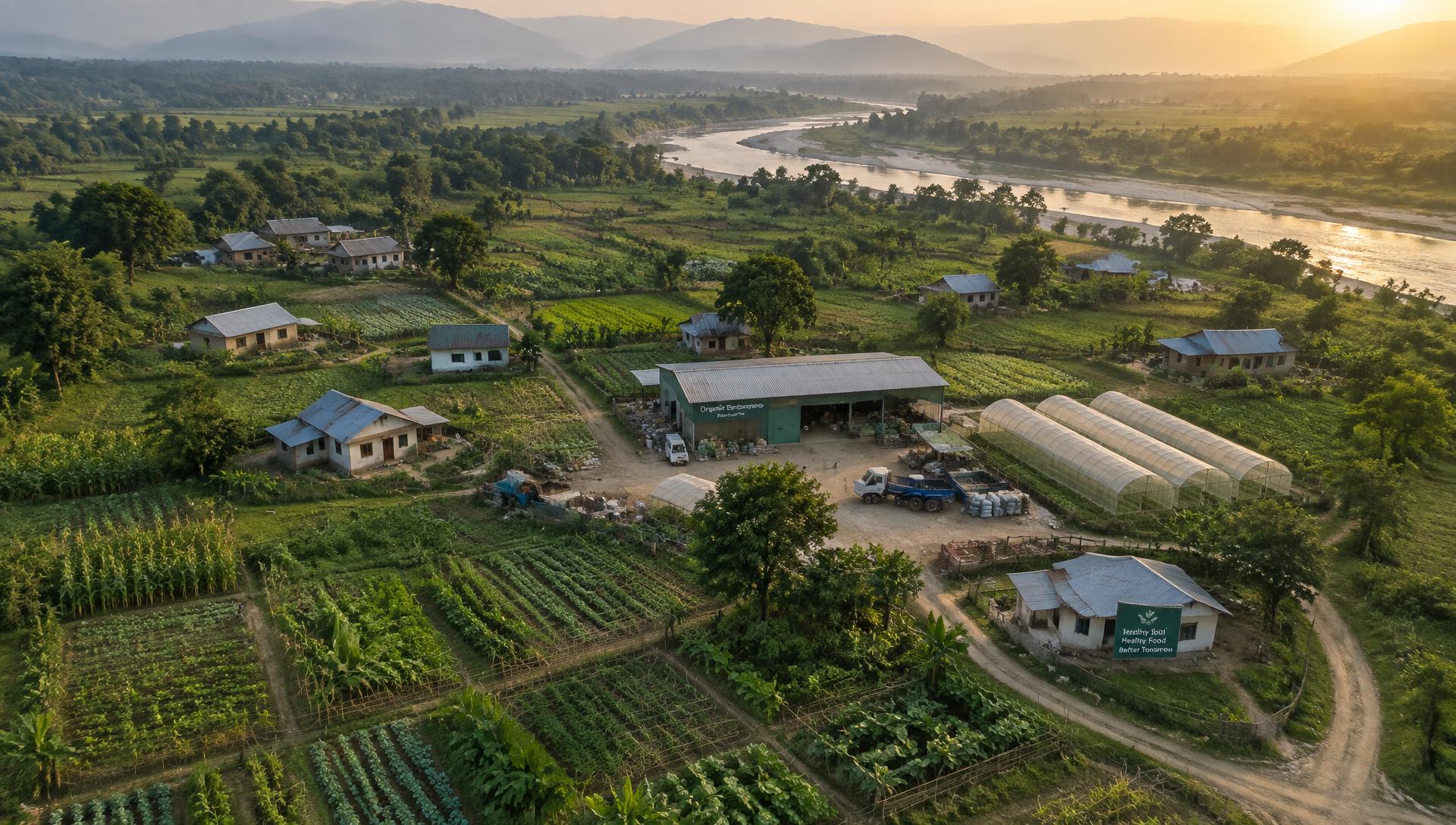
Buddha Food System grows by territory, not farm by farm. People, places and shared infrastructure are planned together, so that each new region can support a full cluster and, in time, train the farmers of the next one. The principle: train broadly, observe carefully, choose progressively, invest selectively, replicate by territory.
1.Scaling farms means scaling capable farmers
Land, methods and money are not enough. Every financed farm is a productive asset entrusted to a person, so the pace of growth is set by the number of people ready to run one. That is why the education system sits at the heart of the scale-up.
2.Recruiting from the whole country
Candidates come from all regions of Nepal, not only from the villages around the training farm. Each graduate may later become the anchor of a new farm in their home region, or in another production basin chosen by BFS.
3.The candidate and the territory together
In the early phases, a candidate is considered together with their territory. Can enough land be gathered nearby for several farms? Are soil, water and climate suitable? Could a cluster one day share infrastructure and services there? Owning land personally is not required; what matters is whether a viable local production basin can be assembled.
4.No isolated farms
A new region needs more than one financed farm: collection and logistics, agronomy support, equipment and services, market coordination, data and administration, sometimes post-harvest facilities. These shared functions form the L2 level of the network. Their costs only make sense when enough farms are close by.
5.The first cohorts as a map
The first cohorts are therefore strategic. Their home regions help decide where the first regional hubs will be built, and spreading them across different climates and basins reduces the exposure of the whole portfolio to a single flood, drought or pest.
6.The loop that feeds itself
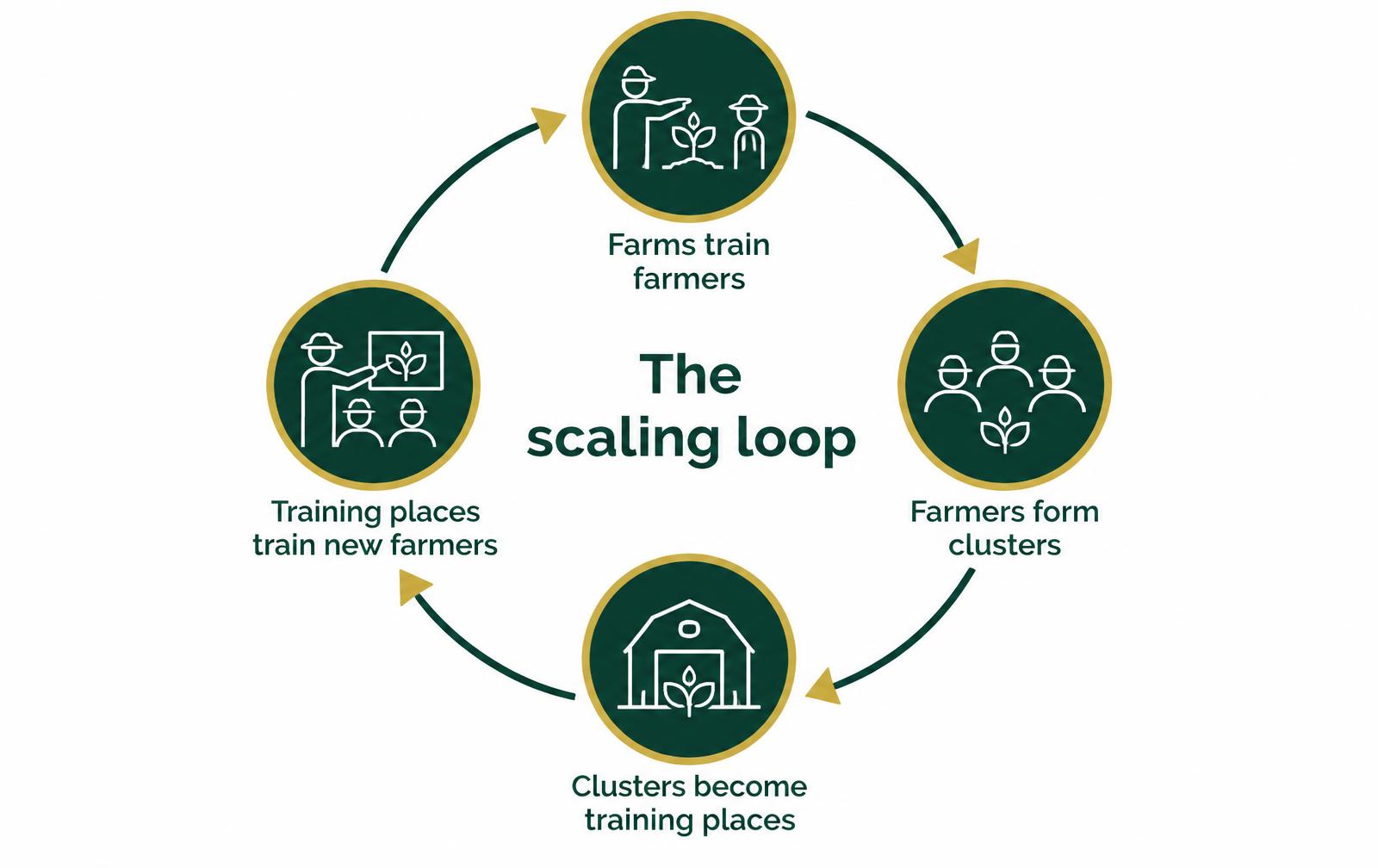
The long-term model is a loop. Productive farms train experienced operators; these operators form new clusters; mature clusters become training places; and those places train the next farmers. Training, production and territorial growth reinforce each other, and a central school gradually becomes a national network of learning farms.
7.Quality before speed
The same standards apply everywhere, adjusted to each region's crops, water, calendars and markets. Trainers are prepared and quality is checked before a cluster starts training others. Growing too fast, with weaker supervision or a lower bar for entrusting farms, would pass training weaknesses straight into the investment portfolio.
8.What we track
BFS follows the scale-up with a small set of indicators:
- where candidates come from, by region;
- progression and retention at each step of the path;
- share of graduates who receive a farm or a network role;
- survival and performance of farms after deployment;
- time needed to form a viable cluster in a new region;
- geographic spread of the farm portfolio.
Cohort sizes and ratios are working assumptions, adjusted as evidence comes in.
See the New education system, and Financial engineering for the path from 1 to 1,000 farms.