
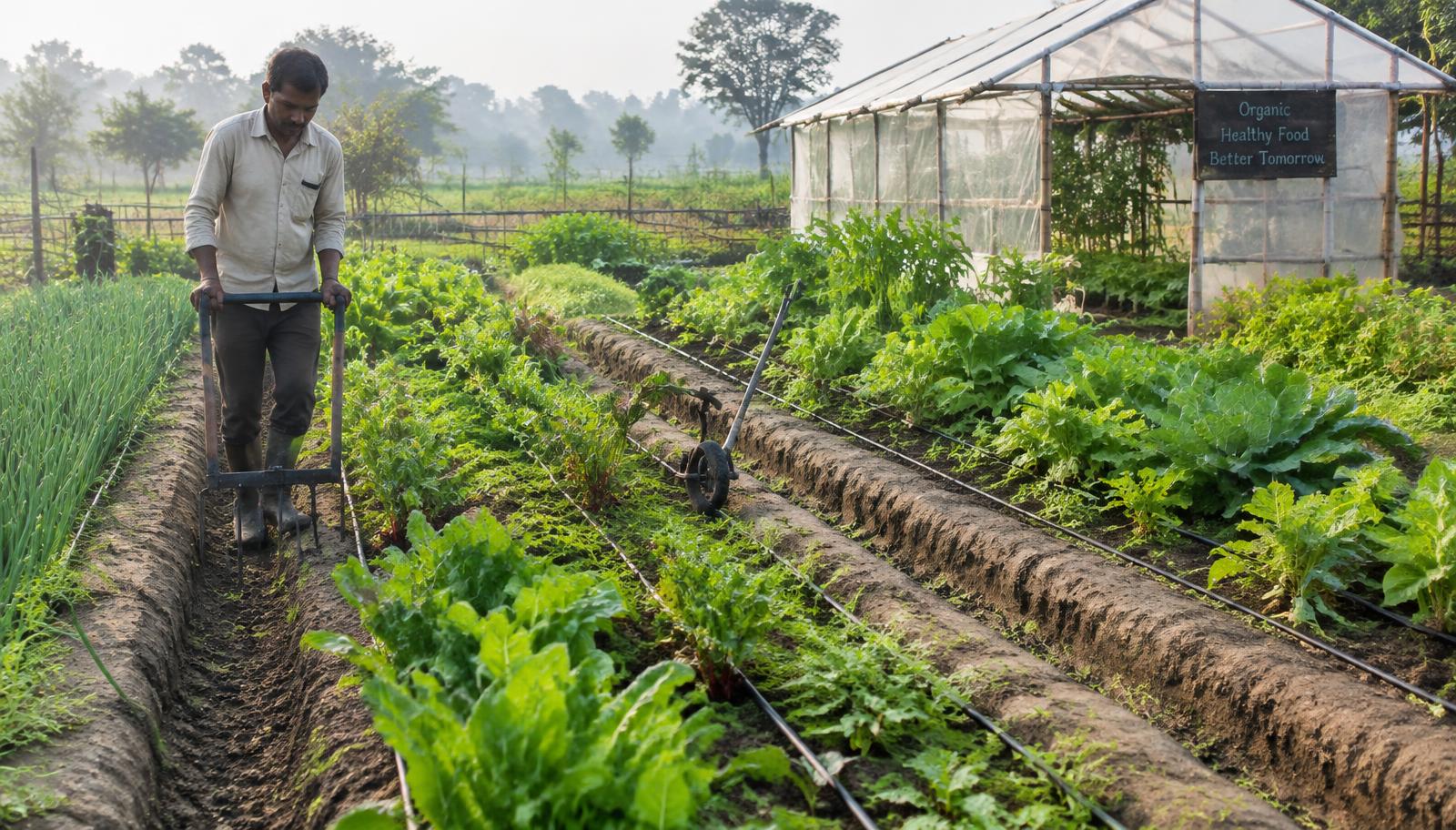
In Nepal, land is scarce and plots are small. Conventional advice says a farm must grow bigger to become viable. Bio-intensive market gardening says the opposite: a small farm can be highly productive and profitable if every square metre is planned, fed and worked with care. The goal is not to maximise acreage, but the value produced per unit of land and per hour of work, while keeping soils alive and crops diverse.
This is the method developed for more than a decade at Spiral Farm House, on about one hectare, and it is the productive heart of every Buddha Food System farm.
1.Where the method comes from
Bio-intensive growing has old roots in the market gardens of Europe and in family gardens across Asia. It was renewed by farmer-entrepreneurs such as Jean-Martin Fortier in Quebec, who showed that rigorous crop planning, intensive cultivation, well-chosen small tools and sound management can make a farm of under one hectare a real business. Sudarshan Chaudhary adapted these principles to the climate, soils, markets and culture of the Nepalese Terai, and combined them with agroecology, biodynamics and Tharu farming knowledge.
2.Permanent beds, never walked on
The farm is laid out in narrow permanent beds of standard size, separated by paths. The soil in the beds is never compacted by feet or heavy machines, so it stays loose, airy and full of life. Because every bed has the same dimensions, tools, irrigation lines, seed quantities, compost doses and harvests can be planned and compared bed by bed. Standard beds are also what makes the farm reproducible from one farmer to the next.
3.Dense planting and successive crops
Vegetables are planted closer together than in open fields, so that leaves cover the soil, keep moisture in and shade out weeds. As soon as one crop is harvested, the next one takes its place, often raised in advance in the nursery. Over a year, the same bed carries several crops. Associations and rotations spread risk, limit pests and keep the soil in balance: a bad season for one vegetable is never a bad season for the whole farm.
4.The nursery, the engine of the farm
Most crops start in a nursery, protected from heavy rain, heat and pests. Seedlings go into the field strong and ready, which shortens the time each crop occupies a bed and allows the rhythm of successions to hold. A good nursery is often the difference between a garden and a professional market farm.
5.Planning like an enterprise
Nothing is left to chance. Before the season, the farmer plans what will be sown, when, on which bed and for which buyer, and follows costs, harvests and sales week by week. In the Buddha Food System network, this farm plan is connected to the network's crop plan and to real demand, including orders from the Magic Organic app. The farmer learns to manage the farm as a business: cash, customers, quality and the economics of the capital invested in it.
6.Small tools, the right amount of machinery
Bio-intensive farms rely on precise, light equipment: broadforks, wheel hoes, seeders, drip irrigation, simple greenhouses and small motorised tools where they save real time. Heavy tractors are not needed. What is too expensive for one farm is shared at the level of the cluster, and simple tools can progressively be manufactured in Nepal.
7.Why it matters for Nepal and for investors
Spiral Farm House has shown that a small organic farm run this way can generate substantial recurring revenue, with the normal ups and downs of seasons and crop cycles. For young Nepalis, it turns farming into a skilled and dignified job. For investors, it turns a small plot into a standard, measurable production unit whose costs and results can be compared from farm to farm — the condition for financing hundreds of them.
Related: Agroecology · Biodynamics · Spiral Farm House · New education system · Planning