
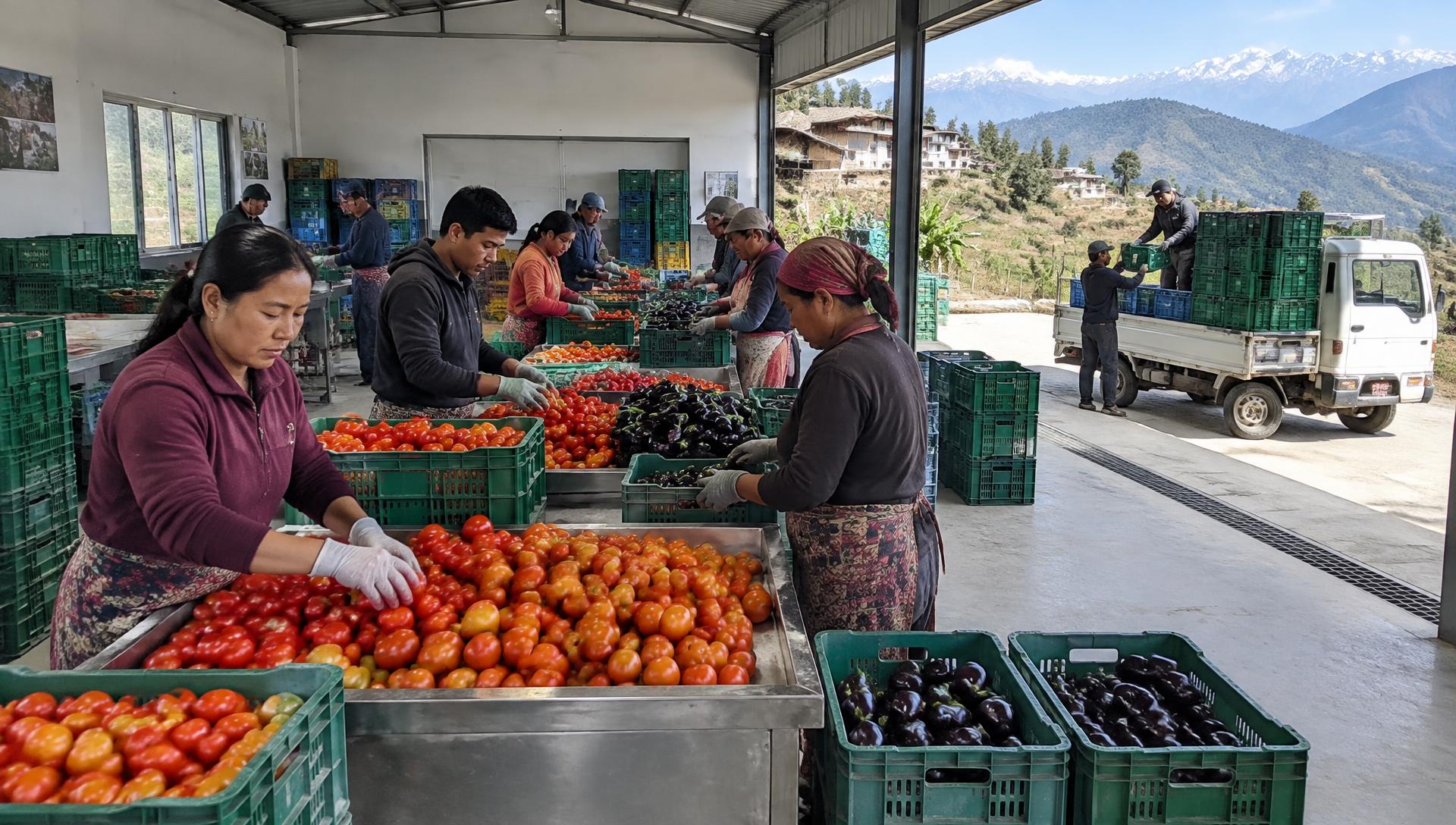
In Nepal, a large share of fresh produce is lost between the field and the plate: no cold storage, poor packaging, long roads. Buddha Food System organises the chain end to end, so that what is grown reaches a buyer in good condition.
1.The chain, step by step
| Step | Where | What happens |
|---|---|---|
| Harvest | Farm | Picked at the right stage, into standard crates, recorded by lot |
| Collection | L1 cluster | Collected from nearby farms, weighed, first quality check |
| Local sale | L1 cluster | Part of the volume is sold to nearby customers through the Magic Organic app and local markets |
| Sorting and storage | L2 cluster | Graded, packed, stored in the regional warehouse |
| Delivery | L2 and BFS | Transported to industrial partners, city distributors or export |
2.Shared infrastructure
Collection points, warehouses, cold rooms and vehicles are too expensive for one farm. They sit in the L1 and L2 clusters, are owned by the company that uses them, and are paid for by all the farms they serve.
3.Reducing losses
- harvest dates planned in advance, so trucks and buyers are ready;
- standard crates and short transport times;
- grading, so lower grades go to processing rather than waste;
- cold storage at L2 level for sensitive crops.
4.Quality and food safety
Each lot keeps its farm and date from harvest to delivery. Quality checks at L1 and L2 follow the same standards everywhere, and any problem can be traced back to the farm and the plot.
5.What investors and buyers get
- reliable deliveries, on agreed dates;
- consistent grades and packaging;
- lower losses, so more value per hectare;
- one supplier for many farms, with lot-level traceability.
Related: Access to market · Magic Organic · Procurement · Traceability & data
Parts of this page describe the intended operating model and will be refined as the network grows. Figures are working assumptions unless they come from the live financial model.