A bio-intensive organic farm lives on compost. Every bed, every rotation, every tonne of vegetables depends on a steady supply of good organic matter returned to the soil. In Europe, a market gardener orders compost by the truckload. In Nepal, good compost in volume is almost impossible to buy, and chemical fertilisers are still the easiest option on the shelf.
Buddha Food System does not leave each farmer to solve this alone. Alongside the market-gardening farms, it develops dedicated fertility businesses — compost factories and livestock units — that produce what the farms need and sell it to them. They are a fundamental part of the system, not an afterthought.
1.Fertility is the first bottleneck
A small farm can be trained, equipped and connected to markets, and still fail if its soil is not fed. Bio-intensive production takes a great deal from the soil each season; biodynamic practice asks that fertility be made on the farm and in the region, not imported in bags. Both mean the same thing in practice: large, regular volumes of mature compost.
One farm cannot produce all of it on its own without taking time and space away from growing food. A network of farms needs a reliable, local source it can plan around, of a known quality, at a known price.
2.The compost factory
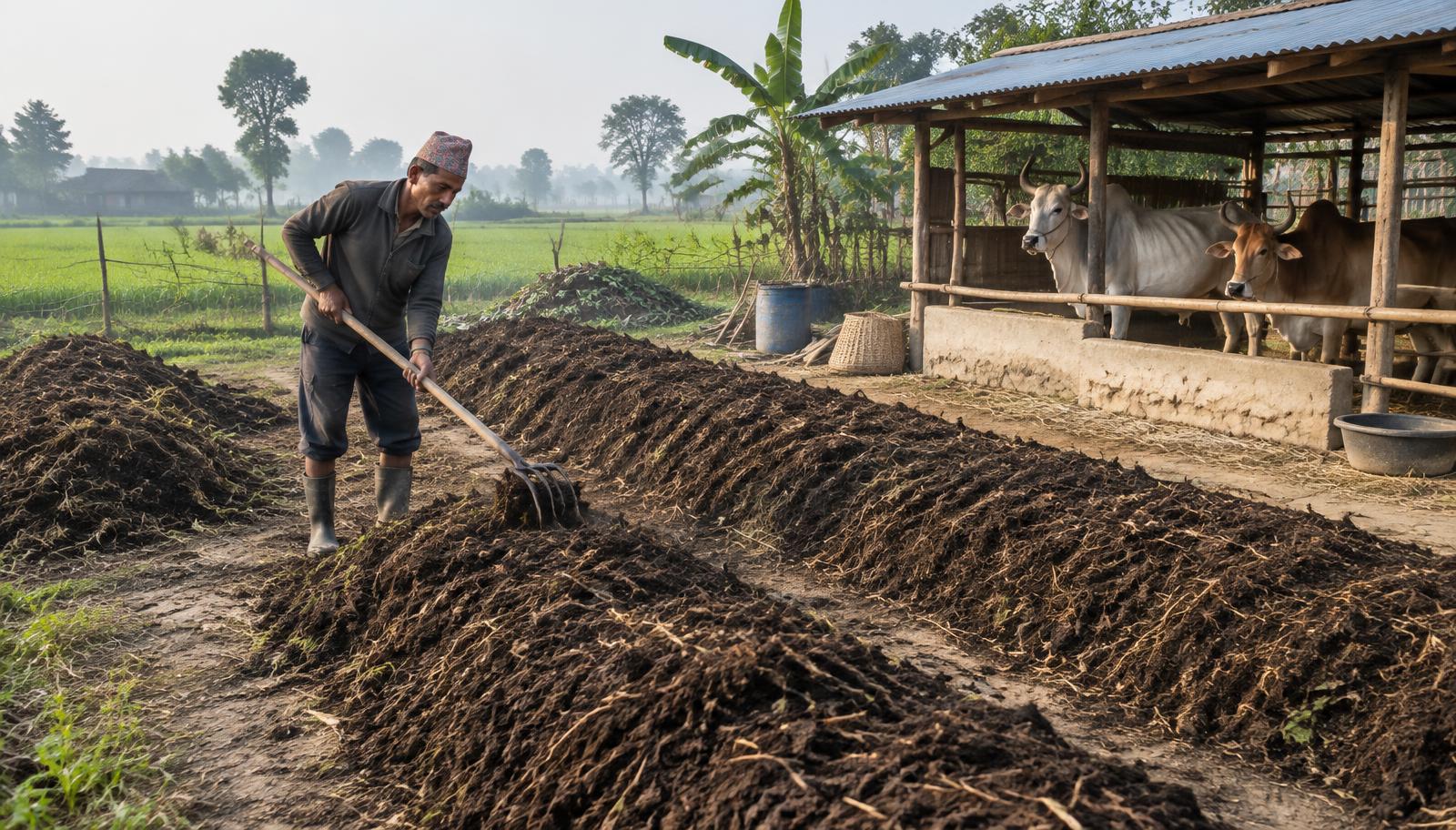
The compost factory collects organic matter — crop residues, green waste, straw and manure — and turns it into mature compost through controlled windrows, turning and curing. It delivers to every farm of its L1 cluster according to the crop plan, so that fertility arrives when the beds need it.
A first compost factory already runs within the BFS system. It is not yet organised as an independent enterprise; the next step is to give it that form, with its own accounts, its own manager and its own customers, so that it can serve as the template for every new cluster.
3.Livestock for cow dung
Good compost needs manure, and biodynamic preparations rely on cow dung. Livestock units therefore sit next to the compost factories: small herds, cared for properly, whose dung feeds the compost and whose milk and other products bring their own income. In the Terai, cattle have always been part of the farming system; the network simply gives them a clear economic role again.
4.Enterprises of their own, attached to L1
Compost factories and livestock units are run like the farms: each one is an individual enterprise, owned and operated by an entrepreneur, and associated with an L1 cluster. BFS pilots them in the same way it pilots the farms — standards, planning, training, follow-up and access to finance.
Their customers are first the farms of the cluster, which gives them predictable demand from day one. That captive demand is what makes them financeable: an investor is not betting on an uncertain market, but on a supplier to a planned network.
5.What it brings to the network
Fertility produced locally replaces imported chemical inputs, lowers costs for the farms and keeps value inside the region. It rebuilds soil organic matter and stores carbon, which supports the network's climate reporting. It creates new jobs and new entrepreneurs who are not growers. And it gives every cluster the same foundation: when a new L1 opens, its compost and livestock units open with it.
Related: Procurement · Biodynamics · Climate & carbon · Vision