
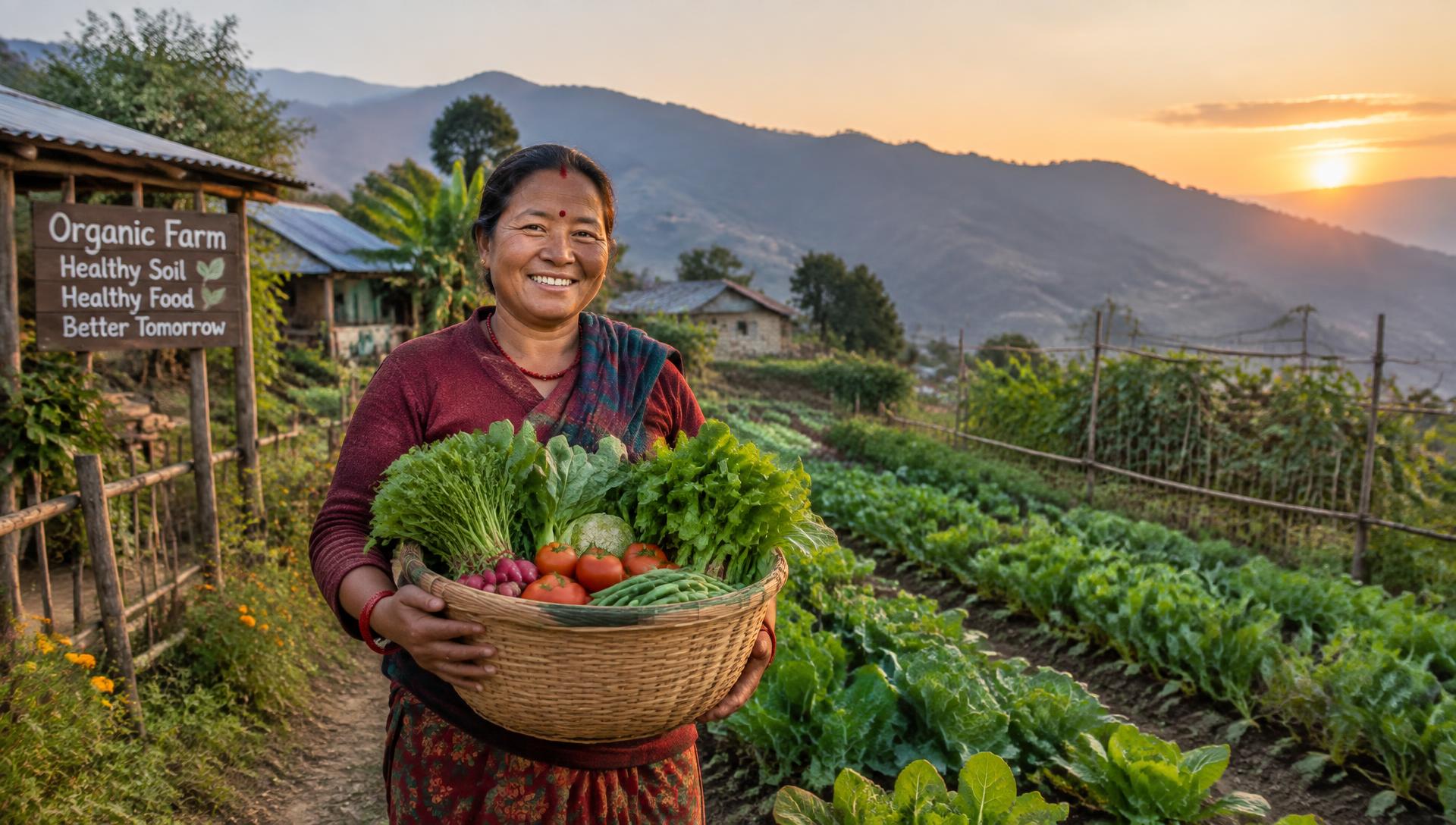
Development programmes often promise to "improve livelihoods". We deliberately do not use that language. It describes small, incremental gains that leave a farmer only a little less poor. Buddha Food System aims at something of another order.
The system is designed to make farmers over-productive — in yield and in money. A farm built, equipped, trained and connected to markets the BFS way produces such quantities that the change of paradigm is total: a farmer moves from living below the poverty line to a level of income that counts as wealthy by Nepalese rural standards.
1.The numbers
| Who | Income | What it means in rural Nepal |
|---|---|---|
| Farm worker | NPR 24,000 per month | Well above typical rural wages |
| Farm owner | NPR 50,000 per month | An income associated with the well-off in rural Nepal |
| The farm, at maturity | NPR 20–40 lakh per year | Sales of vegetables and cash crops |
2.Why we don't talk about "improving livelihoods"
"Improving livelihoods" accepts that farming stays a survival activity, only slightly better paid. Our starting point is the opposite: farming can be one of the best-paid occupations in rural Nepal, if the farmer has the know-how, the rigour and the equipment. With permanent beds, successive crops, living soils, planning and guaranteed buyers, one farm produces tens of tonnes of food a year. That productivity is what pays the farmer, the workers and the repayment of the farm — and still leaves a substantial profit.
3.Ownership without upfront money
The farmer brings no money upfront. The farm package is financed by the network's partners and repaid from sales. Once it is repaid, the farmer only pays the L1 cooperative commission, and may leave the network under simple exit rules.
4.Where the farmer's income comes from
| Source | How |
|---|---|
| Sales | Most of each sale, after the L1 commission and package repayment |
| First-year salary | One year of salary built into the initial farm investment |
| Carbon | About half of the carbon credits earned |
| Shared profit | BFS pays out about 50% of its net profit to farmers, once past losses are covered |
5.Decent work
- free training, and paid work during the apprenticeship through the food produced;
- clear rules on working time, rest, safety and housing;
- no child labour, and fair pay for farm workers;
- a voice in the L1 cooperative.
6.Inclusion
Recruitment, training and housing are designed so that women, young people and indigenous communities can take part and own farms. Participation is tracked by the network.
7.What we track
- net income per farmer, against a living-income benchmark;
- share of women among farmers and staff;
- jobs created per farm and per cluster;
- farms fully repaid and owned outright.
Related: New education system · Access to market · Climate & carbon
Parts of this page describe the intended operating model and will be refined as the network grows. Figures are working assumptions unless they come from the live financial model.